
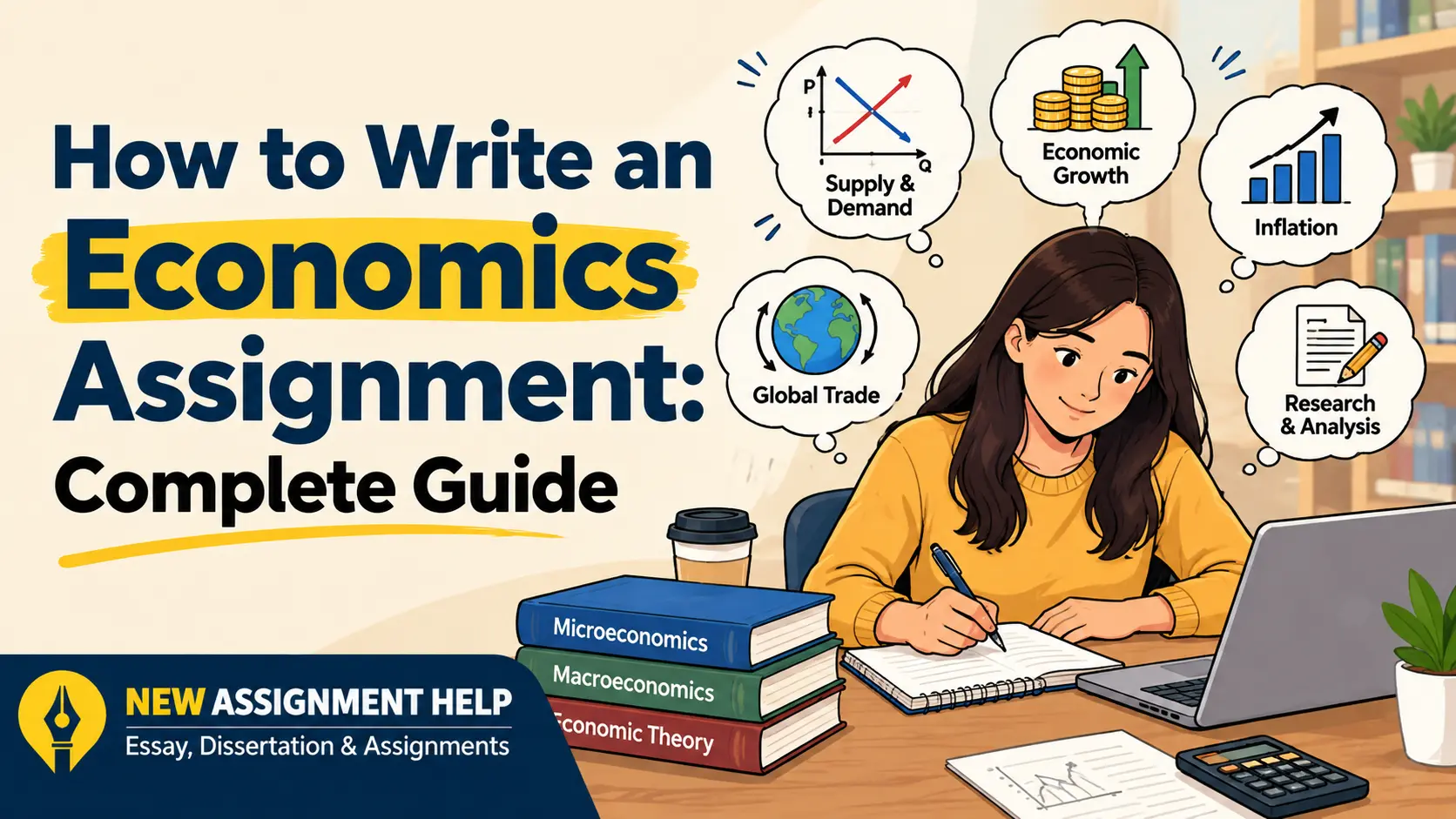
How to Write an Economics Assignment: Complete Guide
- How to Write an Economics Assignment: Complete Guide
- Step 1: Read the Question Twice Before You Start
- Step 2: Build Your Research from Reliable Sources
- Step 3: Plan a Clear Structure
- Step 4: Apply Economic Theories Correctly
- Step 5: Use Real Data and Visuals
- Step 6: Write in Plain, Direct Language
- Step 7: Reference Everything Properly
- Step 8: Proofread Before You Submit
How to Write an Economics Assignment: Complete Guide
An economics assignment needs five things to be done right: a clear understanding of the question, solid research from trusted sources, a logical structure, accurate application of economics models and correct referencing. If you miss any one of these, then even good ideas lose marks. So here is the complete process to help you understand how to write an economics assignment step by step.
Step 1: Read the Question Twice Before You Start
Most students lose marks not because they lack knowledge, but because they answer the wrong question instead of what is asked. So read the assignment brief slowly. Underline the command words such as "analyse," "evaluate," or "compare", because each of them asks for a different kind of answer. "Analyse" wants you to break a topic into parts. "Evaluate" wants your judgment, backed by evidence. Once the question is clear, the rest of the work becomes much easier to plan.
Step 2: Build Your Research from Reliable Sources
Economists mostly use a mix of quantitative data, experimental results and historical records to frame policy. Thus, you should also look up sources like the Office for National Statistics, World Bank reports, IMF publications, and your course textbooks. Avoid random blogs or unverified websites in your assignment as your marker can spot weak sourcing instantly, and it may affect credibility of your work. Keep a simple list of every source as you go. It saves hours later when you build your reference list.
Now, let shape your research with an effective plan and structure.
Step 3: Plan a Clear Structure
This is the most important stage while writing assignment on economics, as it helps you structure your argument logically using the right economics models. And here is the layout:
- Introduction: Begin by writing down your topic and definitions for key concepts and stating your point
- Main body: Explain your analysis in distinct paragraphs
- Diagrams and data: Use graphics and statistics to back up your claims
- Conclusion: Finally, state your conclusion and answer the question at hand
Making a plan first on paper will help you focus your thoughts and prevent you from going off the topic midway through.
Now, let's understand how to execute the plan in clearer steps.
Step 4: Apply Economic Theories Correctly
Every claim in your assignment should connect to a theory or model. Supply and demand, opportunity cost, market failure, elasticity, or whichever applies to your economics dissertation topic, make sure to add relevant theory with that. Also don't just name a theory; explain it in your own words and then show how it applies to your specific question.
This is where many students either shine or fall short. Markers want to see that you understand the theory, not just that you memorised it. Theory alone isn't enough; it needs real numbers to back it up.
Step 5: Use Real Data and Visuals
Economics is mostly based on numbers and including recent statistics, graphs, or charts strengthens your point the most. Also add a well-labelled diagram like a demand curve or a GDP trend line is explained more clearly through visuals than a paragraph of text.
Always label your diagrams and refer to them in your writing ("As shown in Figure 1..."). This shows the marker that you know how to connect visuals to argument.
Now that your content is strong, focus shifts towards how it reads.
Step 6: Write in Plain, Direct Language
Avoid long, complicated sentences just to sound more academic. Clear writing is always smart writing. Go for short paragraphs, active voice, and simple transitions between ideas to make it more effective. If you think a sentence is hard to read aloud, it's probably hard to understand too. Change it. Read your draft out loud once you're done. It's the fastest way to catch clunky phrasing.
Before you submit anything, one more step protects your grade.
Step 7: Reference Everything Properly
Whether your university uses Harvard, APA, or another style, consistency is always the key. All quotations, statistics, and ideas need to be cited. This ensures that the academic writing is your own work rather than plagiarised one. Also check your university's referencing guide to make your assignment more precise.
Step 8: Proofread Before You Submit
Please do these final checks before handing it over to your tutor.
- Spelling and grammar errors
- Repeated points
- Missing citations
- Whether every paragraph actually answers the question
These are the clear steps which will strengthen the credibility of your economics assignment guidance the most. Just use them as your toolbox while starting your work and you will get clear thinking, real evidence, and a structure that guides the reader from question to answer without confusion.
.jpg)
 10 Years | PhD in Applied Economics
Hi Students. I am Zoe Turner from the University of Warwick and your expert for Applied Economics. You can have me for your assignment, dissertation or essay problem. I will guide you towards the right path and help you finish your task on time. You can also get help from me for editing and proofreading your economic papers.