MOD007966 Customer Service Management Assignment Sample
Mercure Liverpool is headed under the umbrella of the Accor group which is renowned across the globe; it is present in the mid-market to upscale segment.
- 92650+ Project Delivered
- 1500+ Experts 24x7 Online Help
- No AI Generated Content



- Introduction Of Customer Service Management Assignment
- Customer Journey Mapping and Service Blueprint
- Components of the Service Blueprint in Detail
- Components of the Service Blueprint in Detail
- Application of Service Blueprint to the Mercure Liverpool Scenario
- Service Blueprint diagram
- Physical Evidence
- Customer Journey
- Onstage Interaction
- Backstage Interaction
- Support Processes
- Customer Emotions
- Fail Points and Their Consequences
- Delayed Reception Services
- Unclean Room Assignment
- Broken In-Room Amenities
- Room Reassignment with Existing Problems
- Maintenance Disregard While On Stay
- Service Recovery Recommendations
- Short-Term Recovery Strategies:
- Long-Term Recommendations for Service Improvement
Introduction Of Customer Service Management Assignment
Mercure Liverpool is headed under the umbrella of the Accor group which is renowned across the globe; it is present in the mid-market to upscale segment. The hotel targets the high-end market with the right price, charging more than the average hotel to appeal to the business as well as recreational travellers who expect value addition by the prices they are charged. Further, customers’ feedback, including the one given in this case, shows that there are substantial gaps between such expectations and delivered services.
This paper aims to analyse specific gaps in service provision as demonstrated by the customer’s posting regarding the dirty nature of a location, poor working, and unsightly housekeeping. This report then aims to provide a service blueprint, and basic fail points analysis of the customer journey for the case organisation and a method to look at the present service failure along its course and come up with measures for its rectification and improved service delivery. It is research-based and looks for solutions that may mitigate deep-seated problems, enhance the customers’ experience, and rebrand the company.
Assignment deadlines piling up? Let New Assignment Help UK ease your burden with expert solutions tailored for student success.
Customer Journey Mapping and Service Blueprint
Overview of Customer Journey Mapping Theory
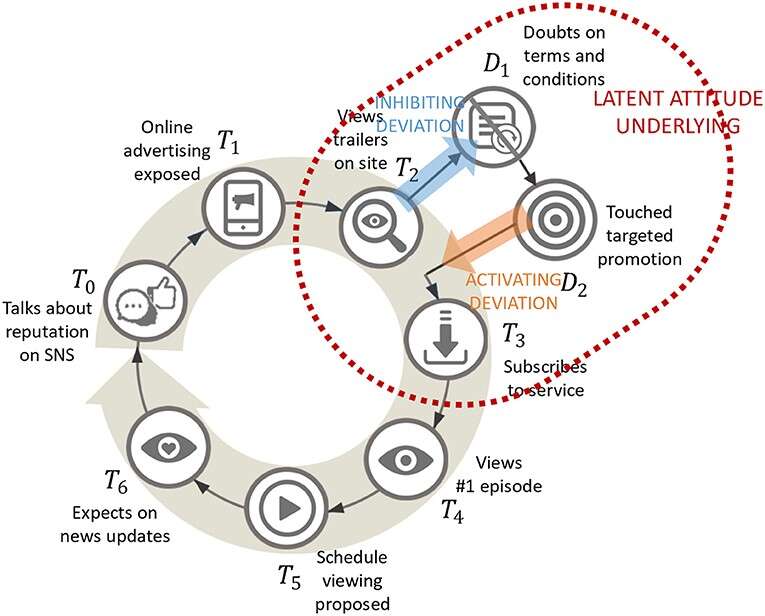
Figure 1: Customer Journey Mapping
The customer journey map is a tool applied to visualize the customer’s experience at different touch points within a service provider or organization (Reitsamer and Becker, 2024). It defines relevant service encounters, customer activities, customer attitudes, and customer frustrations for service providers to discover congruence with customers’ perceptions.
In the hospitality industry, the customer journey typically includes four stages:
- Pre-arrival: Services include Reservation and Correspondence.
- Arrival: This could include processes like check-in and the first impressions that are made.
- Stay: That refers to the access to amenities, contacts with personnel, and perceiving the stay.
- Departure: Check-out and final feedback.
Components of the Service Blueprint in Detail
A Service Blueprint is a surgically detailed working tool that graphically depicts the steps that are inherent in the rendering of a service (Carmona, 2023). It distinguishes the observable interactions between the firm and customers from the less visible and peripheral activities and functions, thus providing a holistic view of the service operating model. The main components include:
- Customer Actions: Activities that the customer performs in the process.
- Frontstage Actions: Customer-staff interfaces which are conspicuous to the rest of the populace.
- Backstage Actions: They include all organizational work, which is related to frontstage work but do not directly perform the interaction between the guest and the organisation’s representatives (Carmona, 2023).
- Support Processes: Enablers that encompass support systems and technology used to reachable service delivery.
- Physical Evidence: Customer characteristics are tangible factors about the environment they are being served and this includes cleanliness and amenities.
Components of the Service Blueprint in Detail
- Customer Actions: Customer action refers to the activities that are done by the customer including at each of the stages in the journey that is under consideration (Rishi and Popli, 2021). In the situation of Mercure Liverpool, these actions consisted of booking, check-in issues and check-out. Every activity gives a chance to satisfy or dissatisfy consumers depending on the delivery of the service.
- Frontstage Actions: Frontstage activities are the activities that are directly observed by the customer including the reception process, and housekeeping services (Rishi and Popli, 2021). At Mercure Liverpool, a long time to check–and inadequate cleaning show poorly managed front-stage actions.
- Backstage Actions: Behind-the-scenes activities are all organizational activities that go into creating a positive customer experience, including deciding which rooms are clean, scheduling housekeeping, and managing in-room supplies (Ghani et al., 2022). These backstage processes when failed caused the unclean rooms and the broken in-room phone.
- Support Processes: Support processes are those that include programs and procedures, policy and instrument part of third-party entities geared towards enhancing service delivery. For example, it is possible to design a housekeeping management software that would remind to clean and maintain rooms and other areas, but the lack of such support at Mercure Liverpool most probably supplemented systematic problems (Ghani et al., 2022).
- Physical Evidence: Tangible evidence refers to what customers can touch or feel during or after the service delivery process, this includes the state of cleanliness of rooms, the quality of furniture as well as the general state of other shared areas (Magnini and Zehrer, 2021). Poor standards of cleaning within the facility such as Mercure Liverpool led to such a perception among the guests regarding the value and quality of the product offered.
Application of Service Blueprint to the Mercure Liverpool Scenario
- Pre-Arrival: The guest had several expectations when he checked in to the hotel with what he saw was the reputation of the brand and the fee that he paid. However, proactive communication to address or even level up this expectation was absent in the study (Magnini and Zehrer, 2021).
- Arrival: At reception, the customer was delayed, and it led to frustration and a lack of trust from the start. The overall dissatisfaction level was heightened by assigning an uncleaned room. This stage revealed reception frontstage failure in the department’s efficiency and room backstage failure (Gazzola et al., 2020).
- Stay: Another area in customer dissatisfaction was the replacement room since it was an instance of service recovery but it had similar problems like long hair in the bathroom and chips near the bed. The bedroom telephone did not work, and this looked like a safety issue; moreover, there was no housekeeping done in the day. These issues showed a lack of housekeeping in backstage areas, along with a lack of adherence to maintenance schedules which is also a form of support system (Kumar et al., 2021).
- Departure: At the end of the stay, the customer demands a proper recovery that includes compensation or an apology that was not made. This stage illustrated some of the lost chances to regain the trust and mend the relationship with the guest (Kumar et al., 2021).
Service Blueprint diagram
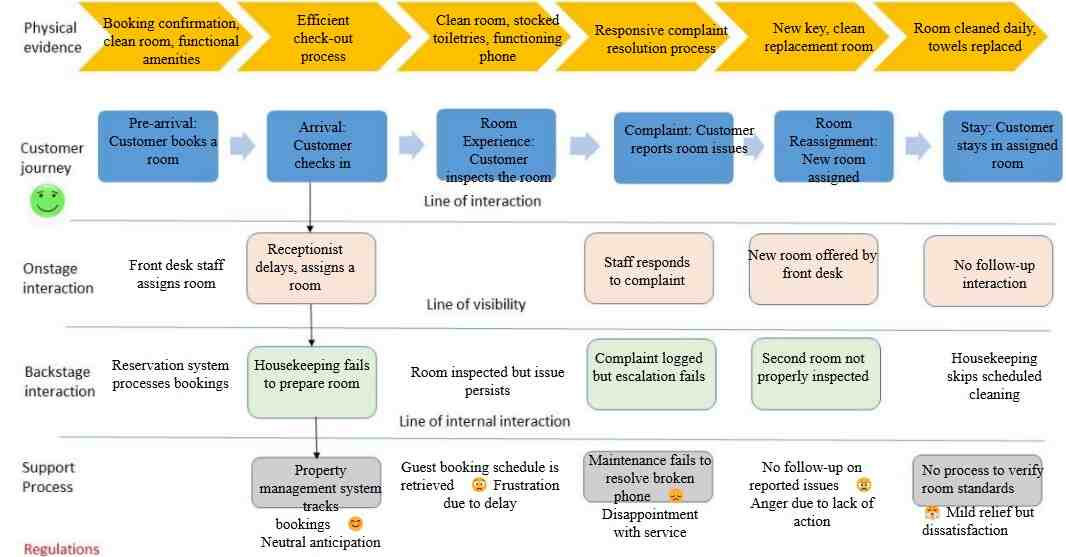
Figure 2: Service Blueprint diagram
Physical Evidence
Physical evidence can also be seen contributing a lot towards the framing of such perceptions by the customers (Uzir et al., 2020). The tangible data at Mercure Liverpool include the cleanliness of the room or amenities, confirmation of bookings and data about how well the amenities work. These aspects define the client’s expectations, especially in a high-end hotel where people pay more to be served with quality standards. But problems such as dirty rooms, unprepared services, and improper in-room telephones affected such expectations. For example, the customer saw the used toothbrush and paste in the bathroom and a non-working phone posed safety issues meaning that the hotel could not meet the expected hygiene standards and functionality (Bruckberger et al., 2023). This dissonance in serving customers was the forerunner to the service failure experience of customers.
Customer Journey
Customer Journey comprises several steps, which include even before arriving at the destination, that is booking (Følstad and Kvale, 2018). At this time the customer can have na neutral attitude toward the stay based on the general image of the hotel and the amount paid for it. However, some problems were identified in the arrival stage, In some cases, it became clear that. From check-in alone, some cases featured some devastating experience which began the process on the wrong note (Chalupa and Petricek, 2024). In a journey, the customer had the experience of his lifetime when he entered the room and the first thing he noted it was unclean. Problems persisted with the switch of the room where the new room also had a problem of dirt (Briffa, Sinagra and Blundell, 2020). These aspects of room preparation and further problems during the stay such as unmet housekeeping needs contributed to the loss of customer satisfaction. The final stage of the process should make the customer have positive feelings towards the product and organisation, but since they did not receive any meaningful service recovery they left the transaction feeling angry and unappreciated.
Onstage Interaction
Onstage Interaction is the perception of how staff in the corporate organization participate in the experience of the customers (Shahrbanoo Yadollahi, Kazemi and Bahram Ranjbarian, 2024). At Mercure Liverpool, the front desk employees were participating in things such as giving out room and dealing with complaints. Nevertheless, the complaint handling behaviour and the responses given at check-in, called for essential Service Delivery failings. They never followed up on cleaning complaints even when they were reported several times during the stay of the guests (Bourdin, Sichtmann and Davvetas, 2023). The staff failed to attend to such matters and address the guest with appropriate solutions or apologies equally displeased the guest.
Backstage Interaction
Backstage Interaction is related to the organisation’s backline activities necessary in providing customer solutions (Shahrbanoo Yadollahi, Kazemi and Bahram Ranjbarian, 2024). Here, problems related to room preparation and some unpreparedness, such as uncleanliness of the rooms and breakages in equipment, can be attributed to problems in the housekeeping department (Bourdin, Sichtmann and Davvetas, 2023). This led to inadequate sanitation and the inability to conduct room checks before allocating the rooms to customers as some of the causes of the service deterioration. Backstage interaction essentially consists of interactions that present backstage dynamics taking place in the background of the onstage interaction. This involves reservation system handling bookings, house keeping deploying rooms and complaint handling. It means customers can be dissatisfied with any delays in the housekeeping or whenever their complains remain unanswered.
Support Processes
Support Processes are the processes supporting service delivery e.g. Property management system for bookings and housekeeping schedules (Wang, 2024). Problems with these systems became apparent as the insufficiencies included a lack of confirmation of the room’s cleanliness and a lack of follow-up on the complaints made. The lack of real-time tracking supported by the propagation of signals to coordinate room cleaning and maintenance requests failed to address certain concerns (Tang et al., 2022). A good supporting system should have been established to detect such issues before degrading into a customer complaint experience. The support process layer determines organization related issues that rear their heads in backstage and onstage processes. Some examples include property management systems that might include bookings and maintenance, issues such as broken phones, or scheduling of cleaning services. Problems or missed calls in this layer only add to guest annoyances.
Customer Emotions
Customer Perceptions evolved from No Feeling at Booking to Frustration, Disappointment, Anger or Disgust during the stay (Ding et al., 2024). During each step of the journey, the feelings of the customer were deteriorating because of unsolved problems. Losses were indicated starting from when the customer checked in to the hotel and other issues such as poor hygiene that elicited negative emotions such as anger and disgust (Herjanto et al., 2021). Remembering a customer’s complaint and failing to follow it up further gives the customer a negative experience.
Effective customer service management relies heavily on well-trained workforce strategies, an area deeply covered under human resource standards where students often utilize
Fail Points and Their Consequences
In the blueprint of Mercure Liverpool, there are several key fail points found in the customer process map that significantly detracted from the guest experience (Rasoul Aliakbari, 2020). Every breakdown in the customer experience cycle costs a lot, provoking higher levels of frustration, and disappointment, and, in the end, eroding customer loyalty. These fail points, especially in the arrival, room inspection, complaint handling and during the stay signal operational inefficiencies and poor service delivery with both short and longer-term implications for the customer's perception of the hotel (Kim, Park and Choi, 2020).
Delayed Reception Services
The first issue of this nature arose when having to check in to the terminal. Lack of swift, polite, and genuinely warm reception, the foundation of many positive service experiences, also negatively influenced the mood of the customer (Rasoul Aliakbari, 2020). First calls or contacts within a hotel or reception staff and if there is a delay in this stage, there is direct disappointment. The customer had no predetermination towards the arrival experience, but it shifting began negatively with the untimely services done at the check-in by Mercure.
- Consequences: The above study shows that the delay in service went further to change the mood of the customer and expected worse to be experienced during the remaining stay (Domanski and Abbasian, 2020). In the hospitality industry perception is very important and a slow check-in timetable means that the guest is likely to get frustrated especially if they are tired after travelling (Xiong, Fan and Qi, 2020). This first failure point undermined people’s confidence in the hotel’s capacity to run its business competently.
Unclean Room Assignment
The second letdown was when the guest was allocated a room that had not been cleaned you could see stains on the bed. On observing the environment of the room a wet toothbrush, toothpaste and a room key card of the previous guest were found (Saleh and Hassan, 2023). This lack of cleanliness is the absence of a cleanliness check during the housekeeping process, which is supposed to prepare the room for the guests.
- Consequences: Imposing penalties are applied in the case of untidy rooms in the scope of the hospitality business (Dhir et al., 2020). Maintenance is part of hygiene, which is the foundation of business and one of the main considerations in choosing a hotel. Personal items left behind by a previous guest were present and it was unhygienic which gave a disgusted look at the hotel (Ko, 2022). Many a time, the customer ended up experiencing feelings of disappointment or frustration once this fail point was reached. It also troubled the brand image that the service was good and served as the cause for challenging organizational cultures.
Broken In-Room Amenities
Another fail point involved the in-room phone not working, which the guest tried to use to call reception (Franco and Muneta, 2023). He had a safety hazard not only with a non-functional phone During the investigation of the occurrence, the guest had to make a call from the mobile phone which also created extra discomfort. A damaged phone was a basic problem that should have been solved during normal maintenance checks.
- Consequences: Deteriorated facilities in a hotel room have a crucial influence on the comfort and security of a tourist (Franco and Muneta, 2023). Communication with the front desk is crucial in any hotel and that is why such a phone is a safety hazard to the guest since he can not be able to call for help in case of an emergency. This is a blow that reveals an inadequacy in the maintenance mechanism of the hotel.
Room Reassignment with Existing Problems
Judging from the guest's experiences, when the guest had identified the problems in the first room he was given another room (Boto-Garcia et al., 2021). Still, it was clear the second room had not been thoroughly cleaned as there was long hair hanging on the wall of the bathroom and chips on the floor close to the bed. This change should have been an excellent chance for the hotel to showcase good service recovery but giving the guest another room that was not clean only piled on the problem (Sutherland and Kiatkawsin, 2020).
- Consequences: The guest had already been frustrated by the first room and even the reassignment to another dirty room this reflected a broken cleanliness and working mechanisms at the hotel. There were times that they ignored the guest’s concerns which made the latter feel unimportant reporting that the poor follow through on the guest’s concern made them feel as if they were cheap or unimportant guests.
Maintenance Disregard While On Stay
The guest also complained that their room was not cleaned and those items provided such as towels and bathmats left behind the bathroom door were not collected. Even though, guest expected daily services of simple things like making of the bed, these standard services were missing. This points more to a chronic problem within the housekeeping department and most importantly poor compliance with service delivery pledges.
- Consequences: Preliminary cleaning experiences by guests are highly affected by the absence of housekeeping services throughout their stay (Park et al., 2019). Fresh towels, restocked amenities, and general maintenance of the room are minimum courtesies while a guest is being housed. Lack of these services was the cause of increased feelings of neglect and dissatisfaction among the recipients.
Service Recovery Recommendations
Short-Term Recovery Strategies:
- Apology and Compensation: The hotel should address an individual sorry letter to the guest who was treated unfairly and provide an actual reimbursement template, including a potential discount for the next visit or a partial money return (Kim and Baker, 2019). This immediate response also expresses responsibilities and hence a call for consumer satisfaction. The guest also should be apologized to by the management of the company and assured that future occurrences of similar incidents will not happen.
- PostOperative Cleaning: In order to regain the confidence of the guests, which they lost in this case, the hotel should hire professional services to deep clean the rooms that were affected and avail the report to the guest (Nandwani and Bhatnagar, 2023). Thus, ensuring that the visitor receives an all-over cleaned and checked-over room with a small token of the hotel’s appreciation will go far in repairing the customer’s faith in the(verbose) cleanliness of the conveniences.
- Crisis Management Training: Hotel receptionists and cleaning services must understand how to manage complaints through sending to a crisis management training program (Nourian, Manian and Nargesian, 2024). They should be trained to be quick in their actions, polite to EU guests and should professionally handle complaints. This would enhance the functionality of complaints most of which are made by guests thereby avoiding cases of guests leaving with bad impressions.
Long-Term Recommendations for Service Improvement
- Additional Health Care Cleaning Measures: Caretakers should be issued with rubrics on the kinds of checks that they should conduct, there should also be supervisor checks to ensure that the rooms are clean before guests arrive (Driscoll et al., 2024). Cleaning attendants should be charged with the responsibility of seeing that rooms are clean to an acceptable level of cleanliness as may be set by the company policy.
- Maintenance Oversight: It should be normal practice to check out the rooms periodically to see that all the amenities within the walls of the specific rooms including the phone, television set and air conditioning system are functioning as they should (Bauer et al., 2021). To avoid such challenges occurring and having an impact on the guests then there is a need to have a strong system for reporting as well as solving matters to do with maintenance (Bauer et al., 2021)e.
- The hotel should have an official complaint-handling channel also post-stay feedback, or feedback during their stay, that will enable clients to air their complaints or views about the improvement that needs to be made (Pillai et al., 2021). This would be very insightful and enable the hotel to establish what it needs to do to improve before such weaknesses worsen.
- The Formulation of a Formal Service Recovery Process: There is need to have a registered service recovery plan to ensure that all the staff involved, address any complaint in the right manner (Al-Dmour et al., 2021). This strategy should indicate when and how to give out compensation, when and how to apologize and how to follow up with visitors.
List of References
- Al-Dmour, R., AlShaar, F., Al-Dmour, H., Masa’deh, R. and Alshurideh, M.T. (2021). The Effect of Service Recovery Justices Strategies on Online Customer Engagement Via the Role of ‘Customer Satisfaction’ During the Covid-19 Pandemic: An Empirical Study. Studies in Systems, Decision and Control, 5(4), pp.325–346. doi:https://doi.org/10.1007/978-3-030-67151-8_19.
- Bauer, A., Möller, S., Gill, B. and Schröder, F. (2021). When energy efficiency goes out the window: How highly insulated buildings contribute to energy-intensive ventilation practices in Germany. Energy Research & Social Science, 72(4), p.101888. doi:https://doi.org/10.1016/j.erss.2020.101888.
- Boto-Garcia, D., Escalonilla, M., Zapico, E. and Baños, J.F. (2021). Scale heterogeneity in hotel guests’ satisfaction relative to room rates. Applied Economic Analysis, 29(87), pp.208–225. doi:https://doi.org/10.1108/aea-07-2020-0093.
- Bourdin, D., Sichtmann, C. and Davvetas, V. (2023). The Influence of Employee Accent on Customer Participation in Services. Journal of Service Research, p.109467052311717. doi:https://doi.org/10.1177/10946705231171740.
- Briffa, J., Sinagra, E. and Blundell, R. (2020). Heavy metal pollution in the environment and their toxicological effects on humans. Heliyon, 6(9), p.e04691. doi:https://doi.org/10.1016/j.heliyon.2020.e04691.
- Bruckberger, G., Fuchs, C., Schreier, M. and Osselaer, van (2023). Retailing Groundedness: How to improve customer experience, brand perceptions, and customer loyalty through feelings of groundedness. Journal of Retailing, [online] 99(4). doi:https://doi.org/10.1016/j.jretai.2023.11.004.
- Carmona, M. (2023). Coding urban design: Constructing a wireframe for a place-focused urbanism. Progress in Planning, p.100775. doi:https://doi.org/10.1016/j.progress.2023.100775.
- Chalupa, S. and Petricek, M. (2024). Application of revenue management practices in short-term rental management. Journal of Revenue and Pricing Management. doi:https://doi.org/10.1057/s41272-024-00516-3.
- Dhir, A., Talwar, S., Kaur, P. and Malibari, A. (2020). Food Waste in Hospitality and Food Services: A Systematic Literature Review and Framework Development Approach. Journal of Cleaner Production, [online] 270. Available at: https://www.sciencedirect.com/science/article/pii/S0959652620329061.
- Ding, K., Gong, X.Y., Huang, T. and Choo, W.C. (2024). Recommend or not: A comparative analysis of customer reviews to uncover factors influencing explicit online recommendation behavior in peer-to-peer accommodation. European Research on Management and Business Economics, [online] 30(1), p.100236. doi:https://doi.org/10.1016/j.iedeen.2023.100236.
- Domanski, M. and Abbasian, S. (2020). The concept of a smart hotel and its impact on guests’ satisfaction, privacy and the perception of the service quality. [online] Available at: https://www.diva-portal.org/smash/get/diva2:1466862/FULLTEXT02.
- Driscoll, N.M., Gerhardt, P.F., Weiss, M.J., Tereshko, L.M., Dixon, M.R., Kazemi, E. and Cox, D.J. (2024). A qualitative analysis of expert interviews on safety and risk. Journal of Intellectual Disabilities, 5(3). doi:https://doi.org/10.1177/17446295241277920.
- Følstad, A. and Kvale, K. (2018). Customer journeys: a systematic literature review. Journal of Service Theory and Practice, [online] 28(2), pp.196–227. doi:https://doi.org/10.1108/jstp-11-2014-0261.
- Franco, M.J.S. and Muneta, M.E.A. (2023). Why do guests stay at Airbnb versus hotels? An empirical analysis of necessary and sufficient conditions. Journal of Innovation & Knowledge, 8(3), p.100380. doi:https://www.sciencedirect.com/science/article/pii/S2444569X23000768.
- Gazzola, P., Pavione, E., Pezzetti, R. and Grechi, D. (2020). Trends in the Fashion Industry. the Perception of Sustainability and Circular Economy: a Gender/Generation Quantitative Approach. Sustainability, [online] 12(7). doi:https://doi.org/10.3390/su12072809.
- Ghani, B., Zada, M., Memon, K.R., Ullah, R., Khattak, A., Han, H., Montes, A.A. and Castillo, L.A. (2022). Challenges and Strategies for Employee Retention in the Hospitality Industry: A Review. Sustainability, 14(5), p.2885. doi:https://doi.org/10.3390/su14052885.
- Herjanto, H., Amin, M., Okumus, F. and Cobanoglu, C. (2021). Airline service: low-cost-carriers (LCCs) failure and passenger emotional experience. Tourism Review, ahead-of-print(ahead-of-print). doi:https://doi.org/10.1108/tr-01-2021-0025.
- Kim, K. and Baker, M.A. (2019). The Customer Isn’t Always Right: The Implications of Illegitimate Complaints. Cornell Hospitality Quarterly, 61(2), pp.113–127. doi:https://doi.org/10.1177/1938965519889288.
- Kim, M.H., Park, J.W. and Choi, Y.J. (2020). A Study on the Effects of Waiting Time for Airport Security Screening Service on Passengers’ Emotional Responses and Airport Image. Sustainability, 12(24), p.10634. doi:https://doi.org/10.3390/su122410634.
- Ko, C.-H. (2022). Exploring Hotel Policies about Cancellation’s Penalties. OALib, 09(02), pp.1–14. doi:https://doi.org/10.4236/oalib.1108427.
- Kumar, R., Verma, A., Shome, A., Sinha, R., Sinha, S., Jha, P.K., Kumar, R., Kumar, P., Shubham, Das, S., Sharma, P. and Vara Prasad, P.V. (2021). Impacts of Plastic Pollution on Ecosystem Services, Sustainable Development Goals, and Need to Focus on Circular Economy and Policy Interventions. Sustainability, 13(17), p.9963. doi:https://www.mdpi.com/2071-1050/13/17/9963.
- Magnini, V.P. and Zehrer, A. (2021). Subconscious influences on perceived cleanliness in hospitality settings. International Journal of Hospitality Management, 94, p.102761. doi:https://doi.org/10.1016/j.ijhm.2020.102761.
- Nandwani, P. and Bhatnagar, D. (2023). Comprehensive and Psychological Review and its Impact on Technology Driven Applications on Business Development and Diversities of Tourism and Hospitality Industry during Pandemic in Indian Prospective. Journal for ReAttach Therapy and Developmental Diversities, [online] 6(8s), pp.405–418. Available at: http://jrtdd.com/index.php/journal/article/view/902.
- Nourian, S., Manian, A. and Nargesian, A. (2024). Developing an Innovative Technology Model for Hotel Reception Desks in Iran. Journal of Information Technology Management, [online] 16(3), pp.150–172. doi:https://doi.org/10.22059/jitm.2024.380494.3772.
- Okazaki, K. and Inoue, K. (2022). Explainable Model Fusion for Customer Journey Mapping. Frontiers in Artificial Intelligence, 5(4). doi:https://doi.org/10.3389/frai.2022.824197.
- Park, H., Kline, S.F., Kim, J., Almanza, B. and Ma, J. (2019). Does hotel cleanliness correlate with surfaces guests contact? International Journal of Contemporary Hospitality Management, 31(7), pp.2933–2950. doi:https://doi.org/10.1108/ijchm-02-2018-0105.
- Pillai, S.G., Haldorai, K., Seo, W.S. and Kim, W.G. (2021). COVID-19 and Hospitality 5.0: Redefining Hospitality Operations. International Journal of Hospitality Management, 94(1), p.102869.
- Rasoul Aliakbari (2020). Comparative Print Culture. Springer eBooks. Springer Nature. doi:https://doi.org/10.1007/978-3-030-36891-3.
- Reitsamer, B.F. and Becker, L. (2024). Customer journey partitioning: A customer-centric conceptualization beyond stages and touchpoints. Journal of business research, 181, pp.114745–114745. doi:https://doi.org/10.1016/j.jbusres.2024.114745.
- Rishi, B. and Popli, S. (2021). Getting Into the Customers, Shoes: Customer Journey Management. Crafting Customer Experience Strategy, pp.21–45. doi:https://doi.org/10.1108/978-1-83909-710-220211002.
- Saleh, H.M. and Hassan, A.I. (2023). Synthesis and Characterization of Nanomaterials for Application in Cost-Effective Electrochemical Devices. Sustainability, [online] 15(14), p.10891. doi:https://doi.org/10.3390/su151410891.
- Shahrbanoo Yadollahi, Kazemi, A. and Bahram Ranjbarian (2024). Investigating the customer-to-customer interaction during the customer journey in banking industry. International Journal of Bank Marketing. doi:https://doi.org/10.1108/ijbm-01-2023-0020.
- Sutherland, I. and Kiatkawsin, K. (2020). Determinants of Guest Experience in Airbnb: A Topic Modeling Approach Using LDA. Sustainability, 12(8), p.3402. doi:https://doi.org/10.3390/su12083402.
- Tang, R., De Donato, L., Bes̆inovićN., Flammini, F., Goverde, R.M.P., Lin, Z., Liu, R., Tang, T., Vittorini, V. and Wang, Z. (2022). A literature review of Artificial Intelligence applications in railway systems. Transportation Research Part C: Emerging Technologies, 140(103679), p.103679. doi:https://doi.org/10.1016/j.trc.2022.103679.
- Uzir, Md.U.H., Jerin, I., Al Halbusi, H., Hamid, A.B.A. and Latiff, A.S.A. (2020). Does quality stimulate customer satisfaction where perceived value mediates and the usage of social media moderates? Heliyon, [online] 6(12), p.e05710. doi:https://doi.org/10.1016/j.heliyon.2020.e05710.
- Wang, P.Q. (2024). Personalizing guest experience with generative AI in the hotel industry: there’s more to it than meets a Kiwi’s eye. Current Issues in Tourism, [online] pp.1–18. doi:https://doi.org/10.1080/13683500.2023.2300030.
- Xiong, W., Fan, F. and Qi, H. (2020). Effects of Environmental Change on Travelers’ Sleep Health: Identifying Risk and Protective Factors. Frontiers in Psychology, 11. doi:https://doi.org/10.3389/fpsyg.2020.00724.