
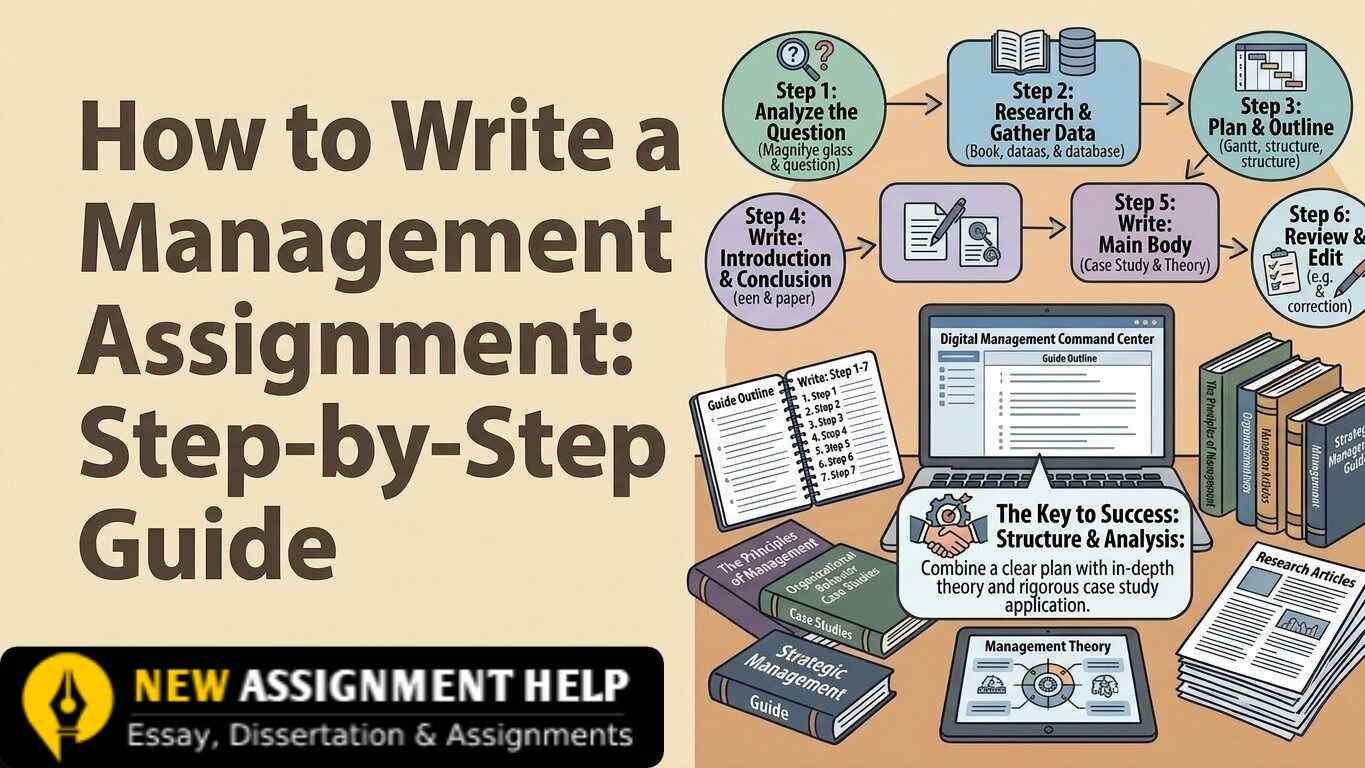
How to Write a Management Assignment: Step-by-Step Guide
- 7 Easy Steps to Write a Management Assignment That Earns Top-Quality Marks
- Step 1: Understand Your Management Assignment Brief
- Step 2: Choose and Narrow Down Your Topic
- Step 3: Research Relevant Management Theories and Evidence
- Step 4: Create a Clear Management Assignment Structure
- Step 5: Apply Management Theories Through Critical Analysis
- Step 6: Write a Strong Conclusion and Recommendations
- Step 7: Reference, Edit and Proofread Your Assignment
- Final Thoughts
7 Easy Steps to Write a Management Assignment That Earns Top-Quality Marks
Wondering how to write a management assignment that scores well? Here is the short answer for better clarity: understand the brief, research, plan, analyse, write and proofread. Many students only describe theories in these assignments and lose marks. Tutors always want to see your understanding and critical thinking. With this, they also require you to link your theories with real business scenarios. Here, solid evidence and practical examples are what lift a grade. So let us guide you through each step, one by one.
Step 1: Understand Your Management Assignment Brief
Read your brief more than once until you understand every word and what they mean. Look for these things:
- The question and learning outcomes
- The marking rubric
- Word count, deadline and referencing style
- Command words like analyse, evaluate, compare and critically discuss
Here is an example. Describe it, and I will ask you to explain it. “Evaluate a leadership theory” asks you to judge it, with strengths, weaknesses and proof. Keep your marking rubric open while you write, because it shows where the marks sit. Once you know what is being asked, choosing a topic will get much easier
Step 2: Choose and Narrow Down Your Topic
Pick a topic that matches your module and brief. Then make it smaller. “Leadership” is a vast concept. “How leadership style affects staff turnover in retail” is far better. Before you commit, check for credible evidence. If you cannot find a few good sources quickly, change the topic because a subject with no proof will make your work less effective.
Step 3: Research Relevant Management Theories and Evidence
Good research always starts in the right places. Use these:
- Academic journals and textbooks (Academy of Management Journal)
- Your university library database (Emerald Insight)
- Free academic search tools (Google Scholar)
- Credible industry reports (McKinsey Global Institute)
- Company annual reports (Tesco annual report)
- Government and official data (ONS statistics)
Mix fresh evidence with the classic theories. Check who wrote each source and when. Save every reference as you go further in your assignment.
Now, the models. SWOT, PESTLE, stakeholder analysis and leadership theories are popular. But choose a model because it fits your question, not because it looks clever. A random model adds words, not marks. Next, you need a plan to hold all this together.
Step 4: Create a Clear Management Assignment Structure
The structure of your management assignment depends on the task. Always follow your university’s instructions first, not a fixed template, as it will affect the credibility of your work.
Introduction and Main Body
An essay uses an introduction, a main body and a conclusion. Each body paragraph should make one point, back it with evidence and link to the question. A report may need an executive summary, headings and findings. Case studies and research projects can look different again, so check your brief.
Conclusion, Recommendations and References
End with a clear conclusion, recommendations if asked, and a full reference list. Plan these early so you do not rush them. Structure ready? Now comes the part that accounts for the most marks.
Step 5: Apply Management Theories Through Critical Analysis
This is where strong assignments beat average ones. Describing tells the reader what a theory is. Whereas critical analysis asks if it works, where it works and why. Try this simple flow for a clear analysis:
- Explain the idea in a few lines
- Apply it to a real workplace or case
- Add credible evidence
- Point out the limits
- Reach a clear judgement
Let us understand this with an example of transformational leadership and motivation in hybrid workplaces. The theory says inspiring leaders boost motivation. Now apply it. A manager who shares a clear vision in team video calls may keep remote staff engaged. Research often links this style to higher engagement. But there is a limit here. Trust is harder to build through screens, and results can change with culture and team size. Your judgement? It works well, but only with regular, personal contact.
Here you have compared, tested and made a decision based on that. That is analysis. Once your argument is built, finish it strongly with more valid points and a strong conclusion.
Step 6: Write a Strong Conclusion and Recommendations
Answer the original question in your very first line. Then sum up your main findings in a few sentences. Do not add new arguments here. If your brief asks for recommendations, keep them specific and based on your evidence. “Hold weekly one-to-one check-ins” beats “improve communication” every time. Your conclusion should flow naturally from your analysis. Last of all, let us polish your work.
Step 7: Reference, Edit and Proofread Your Assignment
Never skip the final step of checking your work. Great ideas can also lose marks through small errors. Go through this list:
- Citations match your referencing style
- Grammar, flow, word count and formatting are clean
- Every key claim has evidence
- The draft meets each point in the marking criteria
Take a short break first and start with a clear mindset to catch more mistakes.
Final Thoughts
Follow these steps to write your management assignment with confidence. Here is a quick overview for you: Brief understood → Topic narrowed → Sources saved → Structure planned → Theories analysed → Conclusion → References checked. Feeling stuck on any step? You can take management assignment support for better clarity.