
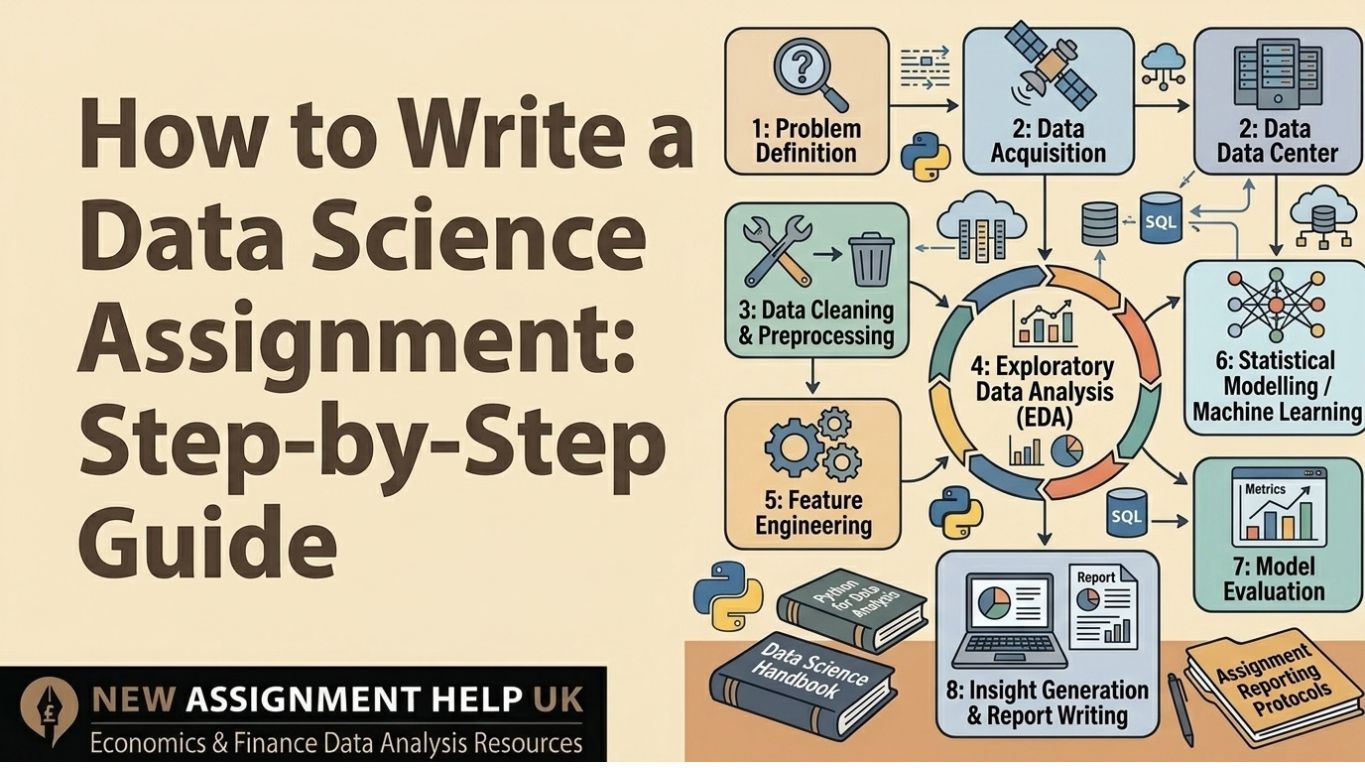
How to Write a Data Science Assignment: Step-by-Step Guide
The code runs, and the accuracy looks great, yet the mark is average. Well, this is common in UK data science modules. Most rubrics give more credit to clear reasoning, sound method choices and honest evaluation than to a high score. A data science assignment asks you to answer a defined question using data, then report your process and findings in a structured way. Here, the 'How to Write a Data Science Assignment Step by Step' guide covers each stage in order, from reading the brief to final checks, so your work matches what UK university markers usually reward.
What Markers Look for in a Data Science Assignment
Most making methods split grades across problem framing, data handling, method choice, evaluation and discussion. With that, code quality and reproducibility often carry marks too, especially when you submit a Python or R notebook. In the UK grading system, a first class (70% and above) normally needs critical discussion on top of working code.
Start by reading the brief two times atleast. Then highlight command words such as analyse, evaluate and justify, because each asks for a different depth. Not the word limit, the required format (report, notebook or both) and any restrictions on data or tools. If marks are weighted, plan your effort to match. A criterion worth 30% should never get a single paragraph. Now with the clear expectations, you can immediately start the actual work.
6-Step Guide To Write A Data Science Assignment
Try to follow all these steps in order, because each step feeds the next one.
Step 1: Frame the problem.
Write your question in one sentence, such as "Which factors best predict student dropout in this dataset?" Then name the task type: regression, classification, clustering or description. This choice shapes every later decision.
Step 2: Source and check your data.
Use the dataset your tutor sets, or a public one from data.gov.uk, the Office for National Statistics or the UCI Machine Learning Repository. Check the licence. If the data holds personal details, UK GDPR and the Data Protection Act 2018 apply, so explain how it was anonymised.
Step 3: Clean and explore.
Look for missing values, duplicates, wrong data types and outliers. Write down each decision and its reason, for example, why you dropped a column or filled gaps with the median. Then plot distributions and relationships, and label every axis with its unit.
Step 4: Build a baseline first.
Start with a simple model first, such as linear or logistic regression. Then try one or two stronger options, like a random forest. After that, split your data into training and test sets before any scaling or imputation. Otherwise, information leaks from the test set. Also, set a random seed so your results can be repeated.
Step 5: Evaluate honestly.
Match the metric to the problem. Use MAE or RMSE for numeric predictions. For imbalanced classes, report precision, recall and F1 score, since accuracy alone can mislead. So, use cross-validation and compare every model against your baseline.
Step 6: Write the report.
Follow the standard structure because that works very well: introduction, data, methods, results, discussion and conclusion. Place each chart next to the text that explains it. While writing the discussion, cover limitations, bias in the data and what you would try next. And don't forget to reference your sources in Harvard style or whatever your module suggests.
Once your draft is written, check it against the errors below precisely.
Common Mistakes That Cost Marks
These errors are flagged by professors after students submit their work. But you try to fix it before the deadlines to avoid easy marks.
- Data leakage: Scaling or imputing before the split gives your model a preview of the test data and inflates the results.
- Unexplained output: Pasted tables and charts with no comment leave the marker guessing. Every figure needs a sentence of interpretation.
- Missing ethics comment: Bias in the training data and privacy risks deserve a short, specific note.
- Unrepeatable code: Absent seeds, hard-coded file paths and unlisted library versions make your results hard to verify.
Not just that, catching these early will actually save a lot of rewriting later.
Pre-Submission Checks
Run through this list once your draft is complete.
- Does the report answer the exact question you stated in Step 1.
- Is the word count within the limit, with code and appendices handled as the brief says.
- Does the notebook run from top to bottom without errors after a fresh restart.
- Is every figure labelled and mentioned in the text.
- Are all sources cited, and is the dataset licence stated.
- Have you followed your university's academic integrity policy, including its rules on AI tool use.
Where the Marks Are Won
Most of the marks in a data science assignment sit in choices that you can explain. Why this model? why this metric? why this cleaning decision? So try to spend your last revision pass on those explanations and on the discussion, instead of just before one more point of accuracy. Try taking help from data science assignment support experts for final check and feedback. Because a modest model with a clear, honest write-up usually beats a complex one that the marker cannot follow.