
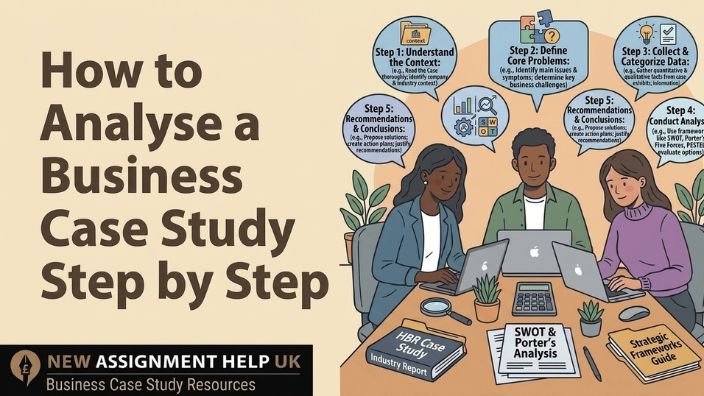
How to Analyse a Business Case Study Step by Step Guide
- Simple Step-by-Step Guide for Business Case Study Analysis
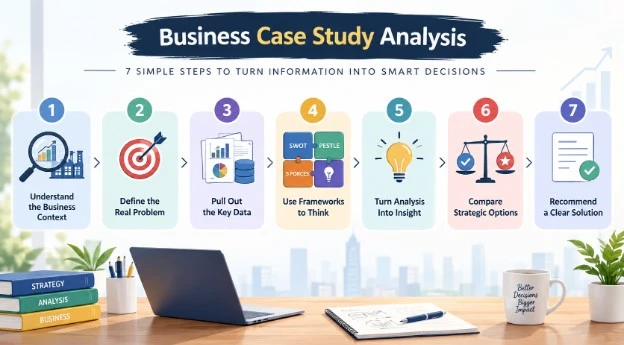
- Step 1: Understand the Business Context First
- Step 2: Define the Real Problem Clearly
- Step 3: Pull Out the Key Data
- Step 4: Use Frameworks to Think, Not to Decorate
- Step 5: Turn Your Analysis Into Real Insight
- Step 6: Compare Strategic Options
- Step 7: Recommend a Clear Solution
- A Quick Example to Bring It Together
- Pro Tips Before You Go
Simple Step-by-Step Guide for Business Case Study Analysis
A business case study analysis is a structured way of examining real-world problems, evaluating different business decisions and proposing data driven solutions. Most of the students struggle in applying theories like SWOT and PESTLE because they don't think like a strategist while analysing. In this guide, you will get a clear, step-by-step method to analyse any business case with confidence. The focus here is on making decisions, not just describing what happened. So let's start with the process of understanding what the business is about.
Step 1: Understand the Business Context First
When you begin working on any framework, make sure you clearly get the background of the business. Ask yourself few simple questions.
- What industry does it belong to?
- Is it retail, tech, or finance?
- Is the market growing or shrinking?
- Is the company a leader, a challenger, or falling behind?
This step matters because strategy always depends on context. A solution that works for a market leader might fail for a small challenger. Thus, never skip this step it will affect your entire analysis. Once you understand the basics, you're ready to look closer at the actual problem.
Step 2: Define the Real Problem Clearly
Students mostly struggle in this step. They spot a symptom and treat it like the problem. For example, saying "profits are falling" is not a real problem statement. It's just an observation.
A sharper way to put it would be: "High operational costs are reducing profit margins in a competitive market." See the difference? One tells you what happened. The other tells you why it happened. Remember this simple rule. A wrong problem always leads to a wrong solution. So take your time here.
Step 3: Pull Out the Key Data
Every case study is full of information, and you have to find the suitable data for your analysis. Look for these three major types of information which you require for any analysis:
- Financial numbers such as sales, costs, and trends.
- Market signals including competition and demand shifts.
- Internal issues like limited resources or slow operations.
When you learn to separate useful data from filler, you will be able to picture the analysis more clearly. Now that you have the right data, bring in your frameworks.
Step 4: Use Frameworks to Think, Not to Decorate
SWOT and PESTLE are useful, but only when you connect the dots. Don't just list strengths and weaknesses side by side. Combine them. For example, a strength paired with an opportunity often points toward a clear growth strategy.
PESTLE works the same way. You can use it to identify outside pressures, like economic shifts or new regulations, and link them to how it affects the business. With this, Porter's Five Forces can also help you in situations where competition is the main issue.
Remember, frameworks are tools for thinking. They are not there to fill space on a page.
Step 5: Turn Your Analysis Into Real Insight
This is the step that separates good analysis from great analysis. Here's an easy way to think about it. High competition leads to price pressure. Price pressure reduces profit margins. That means the business needs a way to stand out from competitors. That chain of thought, from data to meaning to decision, is what insight really looks like.
Step 6: Compare Strategic Options
Most cases have more than one possible path forward. It could be expansion, cost cutting, or repositioning in the market. Look at each option through three lenses. Risk, cost, and feasibility and explain why one option beats the others. That comparison is what shows real strategic thinking.
Step 7: Recommend a Clear Solution
Your final recommendation should solve the actual problem which you had identified in the previous steps. Make sure the suggested outcome is and it backed by the data and insight you built earlier. Do not include information which is not introduced in the section mentioned above.
For example: "Invest in e-commerce to capture online demand and reduce dependency on physical stores." This answer is simple, specific, and grounded in evidence.
A Quick Example to Bring It Together
Reading the steps is one thing. Seeing them in action makes it click. Here is a short example to understand this more clearly.
Example: A Retail Company Losing its Market Share
- Context: Rising online competition in the retail space
- Problem: Weak digital presence compared to competitors
- SWOT: Strong brand name, but poor online capability
- Insight: Customer buying behaviour has shifted online
- Recommendation: Invest in a digital platform and stronger online marketing to boost your performance in the market
How this is effective: The problem could not be solved just by having good brand reputation. The actual problem was a weak online presence, which needed to be addressed.
Pro Tips Before You Go
Keep these in mind every time you analyse a case. Focus on analysis, not just description. Use fewer frameworks, but go deeper into each one. Always follow this chain: problem, then analysis, then recommendation. And ask yourself one simple question throughout: what decision would I actually make here? Good analysis doesn't just explain what happened. It explains why it happened and what should happen next. If you want more clarity on how this works in practice, you can seek business assignment guidance for real insights.
.jpg)
 10 | MBA in Business Management
Rico Woods has spent over 10 years helping UK university students understand different concepts in business assignments. With an MBA degree in Business Management from the University of London and a background in corporate strategy consulting, he understands both sides of the process: what universities expect and where students usually get stuck. Rico has guided hundreds of students through case studies, reports, and research papers across marketing, finance, HR, and operations. He believes strong grades come from clear thinking, not complicated language. Rico reviews academic frameworks to keep his advice practical, current, and genuinely useful.