
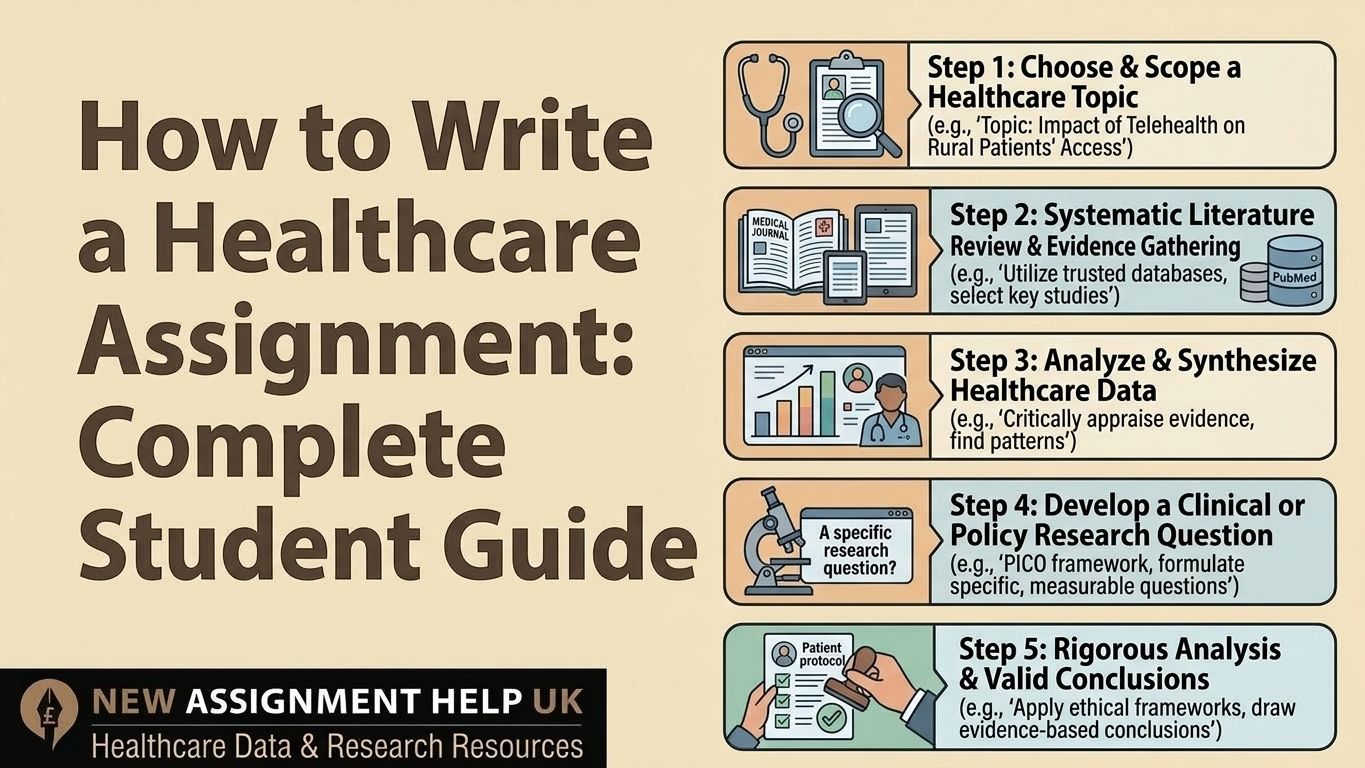
How to Write a Healthcare Assignment: Complete Student Guide
- How to Write a Healthcare Assignment: A Simple Step-by-Step Guide for UK Students
- Start With the Brief and the Marking Criteria
- Find Evidence You Can Trust
- Plan Your Structure Before You Write
- Turn Description Into Critical Analysis
- How Do You Use NHS and NICE Guidelines in Your Writing?
- What Mistakes Cost Students Marks?
- Final Thoughts
How to Write a Healthcare Assignment: A Simple Step-by-Step Guide for UK Students
Wondering how to write a healthcare assignment that earns top marks? Here is a clear answer to this. Writing a healthcare assignment requires you to have a better understanding of your course brief while showcasing practical skills, ethical standards, and structured analysis. It is not a normal essay. UK universities expect evidence-based practice, and they look for NHS and NICE guidance in your work. Therefore, a good structure and strong evidence help you meet the marking criteria, which are clearly explained here.
Start With the Brief and the Marking Criteria
Read the brief and the marking criteria before you start working on anything. The brief explains what your marker is looking for and working without analysing reduces the credibility of your work. Thus, pay close attention to command words. Analyse means break the topic into parts and explain each one. Evaluate means judge how well something works. 'Discuss' means to look at more than one side. Next, match each part of your plan to the marking rubric. Most rubrics check three things: knowledge, analysis, and application to practice. Tutors want strong evidence, clear thinking, and links to real patient care.
Find Evidence You Can Trust
Always use trusted sources to gather credible evidence. NICE guidelines carry the most weight in the UK. Next come NHS England resources, then World Health Organisation (WHO) guidance. After that, use peer-reviewed journal articles. Skip Wikipedia and random blogs, because tutors will not accept them.
Important tip to remember. Research is not about collecting facts only. It is about building a clinical reason for your points. So, each time you make a claim, ask, "What evidence backs this up?" Then place that evidence right next to the claim.
Plan Your Structure Before You Write
Follow the same path a nurse follows with a patient. First, introduce the issue. Then discuss the evidence. After that, apply it to patient care. Finally, evaluate what you found. This one works best when you use the PEEL method inside each paragraph:
- Point: state your idea.
- Evidence: add a source.
- Explanation: say what it means.
- Link: connect it to patient outcomes.
Keep each paragraph on one idea, and use short linking phrases so your reader never gets lost. Think of structure as clinical reasoning on paper.
Turn Description Into Critical Analysis
Describing tells the reader what happened. Critical analysis tells them why it matters and how well it works. Tutors give most marks for the second one. When you write a healthcare essay, build each paragraph in four parts. Introduce the clinical issue. Support it with NICE or NHS evidence. Judge how effective that evidence is. Then link it to patient outcomes. Here is the difference.
Descriptive: "Pressure ulcers are common in older adults. Nurses use repositioning to prevent them."
Critical: "NICE (2014) recommends regular repositioning for adults at risk. This lowers pressure damage, but it needs enough staff. Low staffing can weaken results, so care plans must be realistic."
See how the second one weighs the evidence and asks what could go wrong? That is your goal. Do not just list sources. Compare them, point out where they agree or disagree, and connect theory to what happens on the ward.
How Do You Use NHS and NICE Guidelines in Your Writing?
For nursing assignment writing in the UK, treat these guidelines as your main proof. Reference them the way your university asks, which is often Harvard style. Include the organisation, year, date, title, and link. Check your university guide for the exact rules. NICE guidelines are the gold standard because they rest on strong research and shape real practice.
Here, your tone is also very important. Use clear, simple language. Write in the active voice and stay professional. Avoid vague words. Change "may help" to "NICE recommends" or "nurses should assess". Strong verbs show you know your topic. Now let's look at where students often slip.
What Mistakes Cost Students Marks?
If you need healthcare assignment help, start by fixing these five habits:
- Writing too much description.
- Skipping critical analysis.
- Using weak or missing references, especially NICE and NHS sources.
- Building messy paragraphs.
- Ignoring the command words.
Read your draft once just for these problems. You will be surprised how much you catch. The good news is that every one of them is easy to fix.
Final Thoughts
Now you know how to write a healthcare assignment with confidence. Focus on what earns marks, not just on what to write. Always link evidence to patient outcomes and use more than one source so you can compare. Make sure to use NICE and NHS evidence to build the authority of your healthcare assignment, and your work will look far better than ever. If you want to understand these steps clearly, then healthcare assignment support can make the whole process easier.

 9 | MA in Health and Social Care Management
Thomas Kershaw is a healthcare expert and holds an MA in Health and Social Care Management. He has spent over nine years supporting university students with nursing, health and social care, and healthcare management coursework. Thomas specialises in case studies, evidence-based practice and critical analysis, with a strong focus on NICE and NHS guidance. He has helped hundreds of UK students turn descriptive drafts into clear, well-evidenced work that meets marking criteria. At New Assignment Help UK, Thomas writes practical guides that explain what UK markers in simple words, so students can write their own with confidence