
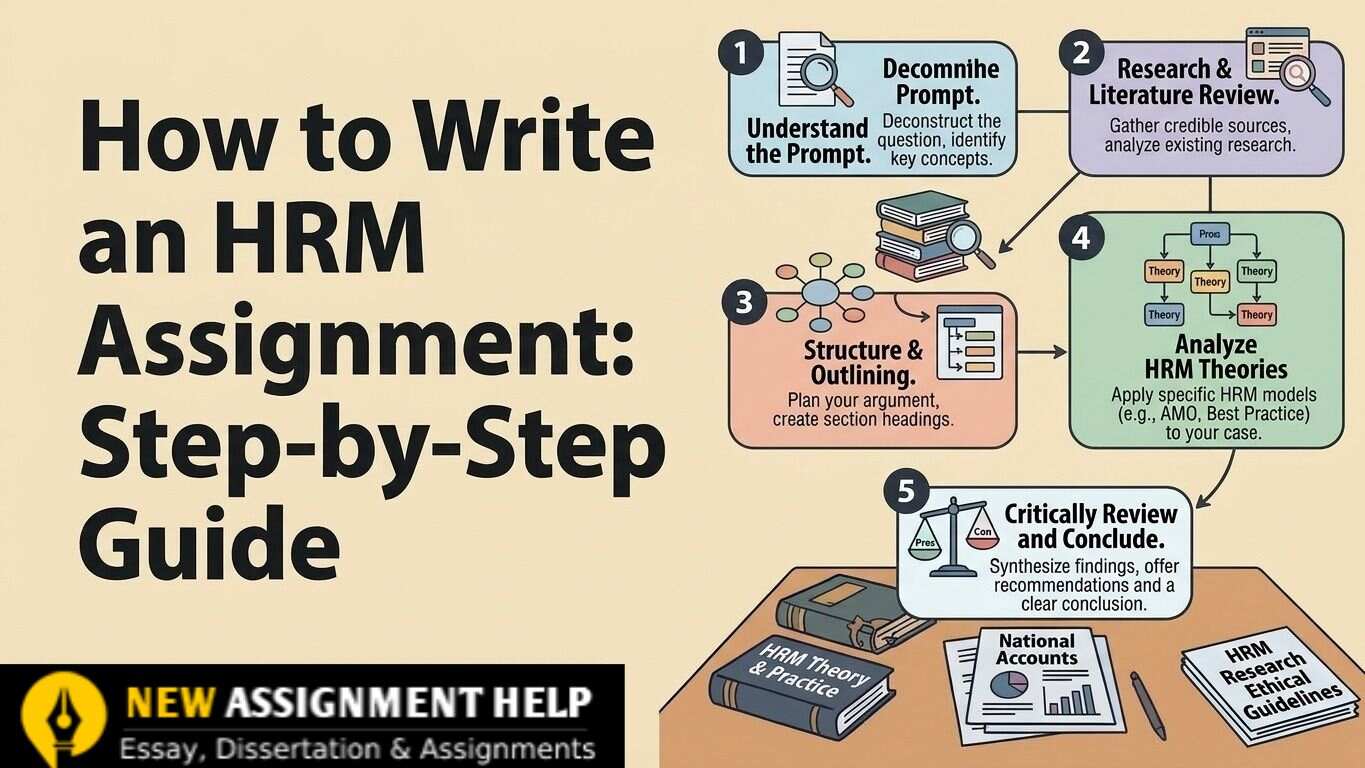
How to Write an HRM Assignment: Step-by-Step Guide
- How to Write an HRM Assignment For Best Academic Results
- Step 1: Understand Your HRM Assignment Brief
- Step 2: Research Relevant HRM Topics and Sources
- Step 3: Choose Appropriate HRM Theories and Models
- Step 4: Create a Clear HRM Assignment Structure
- Step 5: Apply HRM Theories to Real-World Situations
- Step 6: Develop Critical Analysis and Support Your Arguments
- Step 7: Reference, Edit and Review Before Submission
- Even good students slip up. Watch out for these:
- Final Thoughts
How to Write an HRM Assignment For Best Academic Results
An HRM assignment requires you to study how companies manage their workforces using theories and real problems. Most students struggle to write an HRM assignment because of three things: reading the brief, picking the right theory, and going beyond description. But you don't have to worry anymore. In this guide, you will know what your marker wants, how to find strong sources, plan your structure, apply theory, and think critically. Let's walk through it together.
Step 1: Understand Your HRM Assignment Brief
To understand an HRM brief, read the question and marking rubric first, then note the command words, word count, learning outcomes and referencing style you need. Next, turn the question into two or three small research questions for clear understanding. Here is what each command word says:
| Command word | What you should do |
|---|---|
| Analyse | Break the topic into parts and show how they connect |
| Evaluate | Judge how well something works, using evidence |
| Compare | Show how two ideas are alike and different |
| Critically discuss | Consider both sides of the question, then weigh them |
Once you know what is being asked, you can go looking for answers.
Step 2: Research Relevant HRM Topics and Sources
The best sources for an HRM assignment are peer-reviewed journals, academic textbooks and your university library database. The Chartered Institute of Personnel and Development (CIPD) is also great for HR research and real workplace evidence.
Also, write down the citation details as you move further to avoid in-text problems. Remember, a source should support your argument, not just fill space with background. Now that you have good evidence, you need a lens to look through. That is where theories help.
Step 3: Choose Appropriate HRM Theories and Models
Choose theories in management that fit your assignment question, not ones that simply sound impressive. Here are a few popular matches:
- Employee motivation: Use Herzberg's Two-Factor Theory
- Strategic HRM: The Harvard framework can fit here
- Training evaluation: You can go for Kirkpatrick's model
Do not stop by just naming a theory. Explain where it works well and where it falls short in your chosen organisation. One or two theories used properly will beat five that are just listed. With your theories ready, it is time to build your plan.
Step 4: Create a Clear HRM Assignment Structure
A strong HRM assignment has an introduction, a main body and a conclusion.
- Introduction: Say what the topic is, what you will cover, and what your main argument is.
- Main body: Group your ideas into themes. Under each theme, bring in theory and evidence.
- Conclusion: Answer the question directly. Do not add new arguments here.
Not every task looks the same. An essay flows in paragraphs. A report uses headings, findings and recommendations. A case study focuses on one organisation's situation. So always follow your brief, not a one-size-fits-all template. A good plan makes the next step much easier.
Step 5: Apply HRM Theories to Real-World Situations
Applying a theory means using it to explain a real workplace problem. This shows your marker that you truly understand it.
Here is a quick example. Say a company has high staff turnover. You could use Herzberg's theory to ask: are people leaving because they lack recognition and growth chances? Then check company evidence, like exit interview results, to see if the theory fits. Do not stop there. Ask whether something else could explain it, such as low pay or a poor manager. Only then suggest solutions.
Once you can apply theory, you are ready to level up your thinking.
Step 6: Develop Critical Analysis and Support Your Arguments
Critical analysis means judging ideas, not just describing them. You compare views, test evidence and point out limits. See the difference:
- Descriptive: Herzberg says recognition motivates staff.
- Critical: Herzberg says recognition motivates staff, and exit interviews at the company support this. However, the theory is based on a small sample and may overlook individual differences, so it only partly explains why people left.
You can also try this simple paragraph pattern:
- Make your point.
- Add evidence.
- Explain why it matters.
- Mention a limit.
- Link back to the question.
Your recommendations should grow out of this analysis and be realistic for the organisation. Your ideas are strong now. Let's polish them.
Step 7: Reference, Edit and Review Before Submission
Use one referencing style, such as Harvard, from start to finish. Every in-text citation needs a match in your reference list, and every item in your list must appear in your text. Then read your work again. Check that your argument flows, your grammar is clean, and your word count and formatting are right. Compare your draft to the marking criteria one last time.
Even good students slip up. Watch out for these:
- Describing theories without judging them
- Using unsupported claims or old sources
- Ignoring command words
- Giving recommendations that do not match your evidence
- Referencing in different styles
Fix these five, and your grade can jump quickly.
Final Thoughts
A great HRM assignment needs a clear structure, trusted evidence, the right theory and honest evaluation. Follow the steps in order, and use your marking criteria as your final quality check. For more help, you can look for additional guidance on HRM assignments to improve your overall academic skills.