
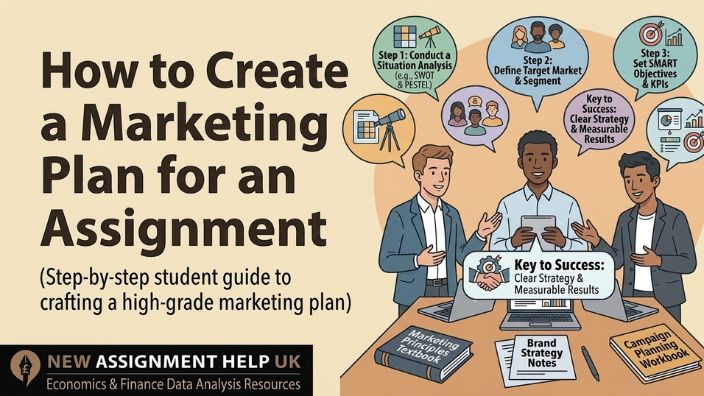
How to Create a Marketing Plan for an Assignment
- Step-by-Step Guide on How to Create a Marketing Plan for an Assignment
- What Your Lecturer Actually Expects
- Step-by-Step Guide to Creating a Marketing Plan
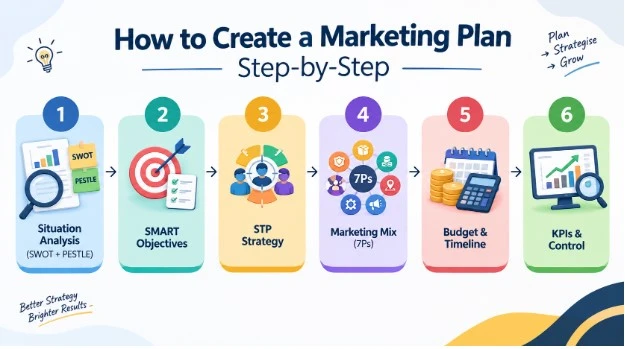
- 1. Start with Situation Analysis (SWOT and PESTLE)
- 2. Set SMART Objectives
- 3. Define Your STP Strategy
- 4. Develop the Marketing Mix (7Ps)
- 5. Budget and Implementation Plan
- 6. KPIs and Control
- Mini Marketing Plan Example
Step-by-Step Guide on How to Create a Marketing Plan for an Assignment
A marketing plan assignment is a structured document that outlines situation analysis, objectives, strategy, tactics, and performance evaluation. A lot of students lose marks here because they write it like a creative essay instead of a strategic and data-driven document. They skip the analytical part or forget to link the sections, which makes them read like a story. So let's fix that. In this guide, we will show you how to create a marketing plan assignment with one small step at a time. And before starting with the steps, begin by understanding what markers actually reward.
What Your Lecturer Actually Expects
Let's start with the expectations of your marker, because they decide your grade. Unlike an essay, a marketing plan doesn't need long arguments. They require you to add specific analytical frameworks and realistic connections and show measurable outcomes in the work you have done. Most UK lecturers like the SOSTAC model, so it helps to know the name.
You mainly have to write a marketing plan using proper structure and data usage and link every section logically. Imagine it as a train line. Every stop will lead you to the next one. Now understand the steps given below to make your own effective marketing plan.
Step-by-Step Guide to Creating a Marketing Plan
Here are the steps in a marketing plan. Do them in the order given below, and you will get a plan that will stand out from the others.
1. Start with Situation Analysis (SWOT and PESTLE)
It is the most important step, as it provides you with a clear and fact-based picture of a company. The main objective of this is to find out the internal capabilities and external market environment of the company before planning anything.
A SWOT analysis lists strengths, weaknesses, opportunities, and threats. For example, a coffee brand might list "strong brand loyalty" as a strength. After that, use PESTLE, as it looks at outside things, like UK inflation, the sugar tax, or new laws on the same. Back it up with real data from Statista or Mintel. Your uni library often gives you free access to both, so use it.
2. Set SMART Objectives
Now that you know the facts, pick your goals. SMART here means specific, measurable, achievable, relevant, and time-bound. Here's the difference between weak and strong objectives:
Weak: Increase sales
Strong: Increase sales by 15% in 6 months through social media campaigns
See how the second one tells your marker exactly what success looks like? That's what you want to do in your marketing plan.
3. Define Your STP Strategy
Your goals are set, so who are you trying to reach? STP helps you decide.
- Segmentation: split the market into groups.
- Targeting: pick the group you want.
- Positioning: decide how that group should see your brand.
Let’s say you're writing about a gym in the UK; then you could target students from the age group 18 to 24 and position it as cheap and friendly.
4. Develop the Marketing Mix (7Ps)
Next, you have to turn that plan into action. For this, the 7Ps show you how:
- Product: what you want to sell
- Price: how much you are going to charge
- Place: from where people can buy it
- Promotion: how you will tell people about the product
- People: staff members and how they treat customers
- Process: how the service is delivered to the customers
- Physical Evidence: proof of the service which people can see, like reviews or packaging
Try to link each P back to your target group. It's a small trick, but it boosts marks and makes your marketing plan much more effective.
5. Budget and Implementation Plan
This is where your plan starts to feel real. Show a monthly budget in pounds and a simple campaign timeline. For example, spend £500 on social ads in month one, then £300 on email in month two. Keep it short. Markers don't want a maths test. They just want to see that you've thought about the cost.
6. KPIs and Control
In the last, explain how you'll check if your plan worked or not. For this, KPIs can be used, as these are numbers that show your progress. However, good ones include:
- Sales growth
- Website traffic
- Conversion rate
Also mention how often you'll check them, like once a month. If a number drops, say what you'll change. That's the "control" part.
This is a short and effective explanation of how you can prepare your own marketing plan assignment without getting stuck on any step. Here is a short example of writing such.
Mini Marketing Plan Example
Let's see all six steps working together with a brand you know. Starbucks wants to grow app orders by 20% in the UK within one year. The main group is young professionals in busy cities like London and Manchester. The strategy is mobile marketing, aimed at the morning commute. One tactic is personalised app discounts, such as a free drink after five orders. The team then tracks app downloads and repeat orders each month.
Observe how each part leads to the next without any vague comments. That flow is what earns marks in your final submission. In addition, please make sure to read your university criteria and use academic references to build the authority of your work.
A well-structured marketing plan improves both clarity and grades. Take it one step at a time, and it will feel much easier. If you'd like to improve your understanding, support on marketing assignments can make the process smoother.
.jpg)
 9 | MBA in Marketing Management
Oliver White is a Manchester-based marketing academic and assignment specialist with an MBA in Marketing Management and more than nine years of hands-on experience. He works with university students at undergraduate, postgraduate and MBA level across the UK, helping them produce clear, practical coursework that meets what markers actually look for. His core strengths sit in marketing plans, case-study analysis, consumer behaviour, digital marketing and brand strategy. Oliver’s approach is straightforward: take the theory, ground it in real business thinking, and turn it into well-structured, persuasive work. The result is writing that feels confident and helps students achieve better grades.