
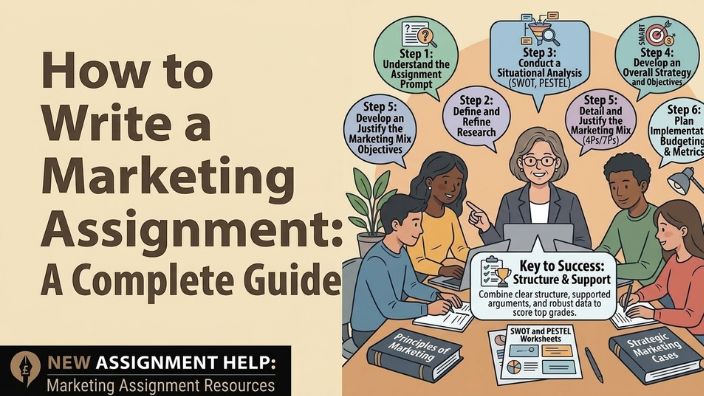
How to Write a Marketing Assignment: A Complete Guide
- How to Write a Marketing Assignment: A Simple Step-by-Step Guide
- What Your Marker Is Looking for in Marketing Assignments
- Step 1: Read the Brief Clearly
- Step 2: Research and Choose a Focus
- Step 3: Choose the Correct Framework
- Step 4: Use Credible Resources
- Step 5: Write to Analyse, Not Just Describe
- Mistakes That Quietly Cost You Marks
How to Write a Marketing Assignment: A Simple Step-by-Step Guide
Marketing assignments require you to work in a creative and analytical way, which is the toughest part here. Most students know the theory but lose marks because they don't know how to combine theories with real-world examples to show their understanding. That is why this guide on how to write a marketing assignment breaks down the whole process into simple steps you can follow easily. With this, you will also learn about the marking expectations and common tips to avoid mistakes which cost significant marks. Let's begin with the part that most guides skip.
What Your Marker Is Looking for in Marketing Assignments
Writing as per the university expectations is the most important criterion to get a good score. Your marker wants to see critical thinking and recommendations backed by data rather than presenting a textbook summary. And writing down what SWOT means will not get you far. Showing how SWOT explains a real brand's problem will.
Keep this in mind and apply frameworks and provide depth over every description to make your work strong. Here are the actual steps to write a marketing assignment.
Step 1: Read the Brief Clearly
Before you research anything, slow down and read the question twice. Look for command words like analyse, evaluate, or critically discuss. Each one has its own working criteria, so follow that.
Analyse means break it into parts and explain how they connect. Evaluate means judge how well something works and back it up with evidence. Critically discussing means weighing up different views before you land on your own.
Make sure to not avoid this step, as it will lead you to answer the wrong question, and your examiner will give you no marks for such mistakes.
Step 2: Research and Choose a Focus
If your brief doesn't mention any analysis company, pick the one whose information you can actually find. A well-known UK retailer or a brand with recent news coverage works better than a small company with barely any data online.
Once you have your focus, start gathering real material around it. Look for market reports, recent news, and examples of what the brand has actually done, not just what it says about itself. Use sound evidence that supports your claim, instead of personal opinion.
Step 3: Choose the Correct Framework
Marketing has a lot of models. SWOT, PESTLE, 7Ps, STP, and more. Pick the one that fits your question and use it well.
Here's a quick guide based on your assignment type:
- Essay question → Essays usually ask about outside factors like the economy or technology; that is why go for PESTLE, as it covers exactly that.
- Case study → In case studies, you have to look closely at one company, so SWOT helps break down its strengths and weaknesses. You can also use STP to analyse who it targets and how.
- Marketing plan → A plan needs to cover the full mix, like price and promotion, and 7Ps walk through each part step by step.
Here is a quick example when your assignment asks you to evaluate a UK retailer's marketing strategy.
A weak answer says, "One strength of the brand is its strong online presence." That's just a fact.
A strong answer says, "The brand's strong online presence gives it an edge over competitors who rely mostly on physical stores, especially since more UK shoppers now research products online before buying in store."
See the difference? The first one just states the fact, but the second one explains why it matters. That is analysis.
Step 4: Use Credible Resources
Do not just Google "marketing trends UK" and grab the first blog you find. Use trustworthy sources like Mintel, Statista, Ofcom, or the ONS website for UK data. These give you real numbers you can quote and reference properly.
If you use AI tools like Claude or ChatGPT, use them to research ideas or organise your thoughts. Do not use them to write your final answer.
Step 5: Write to Analyse, Not Just Describe
Look at these two paragraphs. Both talk about the same idea.
Descriptive (weak): "The company uses social media to promote its products. It posts on Instagram and Facebook regularly."
Analytical (strong): "The company's regular use of Instagram and Facebook lets it reach younger shoppers directly, which matters since this age group increasingly ignores traditional ads. This shows a clear shift toward channels where the target audience already spends their time."
The second version explains the "reasoning": That single habit can lift your grade more than adding another model ever will.
Keep your structure simple. Short intro that states your point. A body that explains and backs up each idea with evidence. A short conclusion that sums up your argument, with no new ideas added in. Before you submit, check the common mistakes below which can affect your grades.
Mistakes That Quietly Cost You Marks
- Naming too many models without applying any of them properly
- Never mentioning a real brand or example
- Writing paragraphs that only describe, never analyse
- Weak links between paragraphs, so ideas feel disconnected
- Skipping the marking rubric completely while writing
Avoid these, and your writing already stands above most submissions. Also frame every section as per your university-required referencing style to back your sources in the most credible way. If you don't know how to do it in practice, then you can also seek guidance on marketing assignment for clear analysis.
.jpg)
 9 | MBA in Marketing Management
Oliver White is a Manchester-based marketing academic and assignment specialist with an MBA in Marketing Management and more than nine years of hands-on experience. He works with university students at undergraduate, postgraduate and MBA level across the UK, helping them produce clear, practical coursework that meets what markers actually look for. His core strengths sit in marketing plans, case-study analysis, consumer behaviour, digital marketing and brand strategy. Oliver’s approach is straightforward: take the theory, ground it in real business thinking, and turn it into well-structured, persuasive work. The result is writing that feels confident and helps students achieve better grades.