Common Psychology Assignment Mistakes and How to Avoid Them
- Common Psychology Assignment Mistakes and How to Avoid Them
- Reasons Why Students Make Psychology Assignment Mistakes
- 8 Common Psychology Assignment Mistakes That Cost Marks
- 1. Ignoring Marking Criteria
- 2. Misusing Famous Studies
- 3. Getting Research Facts Wrong
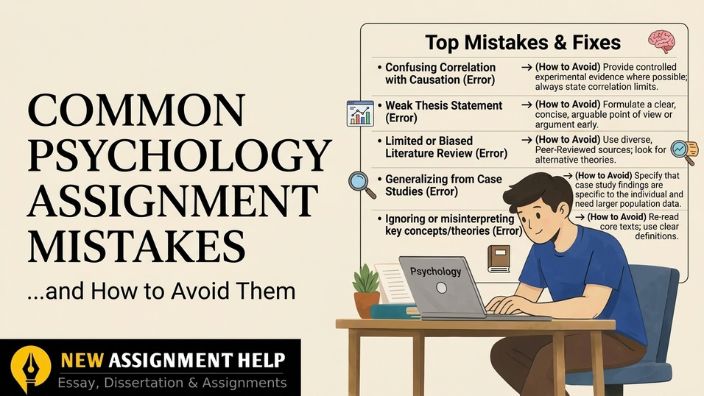
- 4. Confusing Correlation and Causation
- 5. Overgeneralising Research Findings
- 6. Ignoring Research Ethics
- 7. Misusing Psychological Terms
- 8. Poor Evidence Placement
- How to Avoid Common Psychology Mistakes and Ensure Precise Work
- Final Thoughts
Common Psychology Assignment Mistakes and How to Avoid Them
What does it feel like when your professors point out mistakes you didn't even know you were making? The situation can be daunting, but the only way is not to rewrite. Sometimes you need to take wise steps before starting to write by understanding the common mistakes. They can be related to selection, organisation, and evaluation, and you drive a better solution by avoiding them.
But how? Well, this blog is all about describing the errors and missteps so that when you start writing, you know what to avoid. So let’s dive into the guide and see the mistakes that you can make in your psychology assignment.
Reasons Why Students Make Psychology Assignment Mistakes
Errors are indeed caused unintentionally, but still, there are some reasons that occur in the final assessment. Let’s break them down to see what needs to be done before looking at the mistakes:
- Focusing on Knowledge Rather than Argument
When writing a psychology assignment, students often assume that more information strengthens the project. In reality, professors look for how well your answers are justified and whether they’re connected or not.
- Moving from Description to Analysis
If your answer doesn’t demonstrate its meaning, it can be less credible. Also, it makes the psychology assignments more descriptive even when they contain plenty of research.
- Researching Without a Clear Purpose
Research is the core of the subject, but with the right direction, it brings unnecessary information. You need to have a clear idea of what sources you need for the question you will answer.
What you do with the knowledge matters in a psychology assignment, not just filling pages. When you ignore these kinds of practices, it causes mistakes that are explained next:
8 Common Psychology Assignment Mistakes That Cost Marks
Even if it's unintentional, you’re still making the mistakes that cost marks. When you know them, you can prevent them. Let’s have a look at the most common but unusual mistakes below:
1. Ignoring Marking Criteria
While UK academic assessment focuses more on analysis, students make the project too descriptive. That’s what creates a gap between the expectation and your work.
2. Misusing Famous Studies
Students incorporate sources that are not even relevant to their specific argument just because they’re well-known. That’s when the evidence feels forced if the connection is not established.
3. Getting Research Facts Wrong
While adding facts strengthens the assignment, it can ruin the quality too if you mix up researchers, findings, dates, samples or psychological concepts. That abundance often hurts the answer's credibility.
4. Confusing Correlation and Causation
Just making a connection between two variables is not enough because they do not necessarily mean one causes the other. Students often fail to consider what the study design actually allows, which costs marks.
5. Overgeneralising Research Findings
Students often apply the research of one group to many, either in confusion or to save time. While research differs based on participants, culture, age group and research setting, avoiding them causes mistakes.
6. Ignoring Research Ethics
To make their claim worthwhile, students forget ethical considerations. Ignoring relevant ethical issues such as consent, deception, confidentiality and protection can leave evaluation incomplete.
7. Misusing Psychological Terms
Having the right meaning is crucial, but students often misunderstand terms such as validity, reliability, correlation and generalisability. Incorrect use can weaken an otherwise clear argument.
8. Poor Evidence Placement
Using evidence only makes the claim strong when it is connected with it. Here, the mistake often remains placing a study in a paragraph without explaining its relevance.
Now that you understand the mistakes, let’s see how you can avoid them.
How to Avoid Common Psychology Mistakes and Ensure Precise Work
The mistakes seem daunting, but solving them is much easier than you think. With a few necessary steps mentioned below, you can draft an error-free psychology assignment:
- Read the marking criteria properly so you know how you should structure analysis, evidence, etc.
- Verify the researcher, findings, sample, and research methods before adding a study.
- Instead of just making your project look solid, use the terminology only when you know the meaning.
- Consider context by checking who participated in the study instead of broadly applying findings.
- Always cross-check whether you have explained what the evidence means.
- Review your work by looking at references, researcher names, study findings, psychological terminology, and quotations before submission.
That’s how you can change your project quality drastically because you know what needs to be done. It’s time to end this blog with some useful learning.
Final Thoughts
To wrap up, it’s clear that following what is required by professors and not overcomplicating things is the way to avoid mistakes. Once you know them, the process becomes easier, not just to avoid mistakes but also to smooth things out. So whether it is now or next time, when writing a psychology assignment, ask this question to yourself: Have I understood the question? Is my evidence accurate? Am I saying only what the research supports? And does every point actually strengthen my argument?
Get the answer, or you can even look for additional psychology assignment guidance to speed up the process. So no more confusion and unintentional mistakes when you have the roadmap to write strategically.
.jpg)
 6 years | MSc Psychology (Dist.), Behavioural Studies
Hello Everyone I am Emma Harris a Psychology expert. I am also an expert in creating academic content. So if you are struggling with your Psychology papers then feel free to get connected with me. I will understand all your problems and we will work together on your Psychology papers.