
Evidence-Based Practice in Healthcare Studies
- Evidence-Based Practice in Healthcare Studies: A Complete Student Guide
- What Is Evidence-Based Practice?
- The PICO Framework: Your Starting Point for EBP in Healthcare
- The 5 Steps of Evidence-Based Practice
- Where to Actually Find the Evidence in EBP in Healthcare Studies
- Popular EBP Models Used in Practice
- Final Takeaway
Evidence-Based Practice in Healthcare Studies: A Complete Student Guide
Evidence-based practice (EBP) in healthcare is the process of making patient care decisions by combining the best available research, a clinician's own clinical skill, and the patient's personal values and preferences. It's not a theory you memorise once and forget. It's a habit you build, one clinical question at a time.
If you're a nursing or health science student trying to make sense of it, you're in the right place. This guide breaks EBP down step by step, in easy language, with real examples along the way. By the end, you'll know the steps and model used in EBP and how to build a strong clinical question using the PICO framework. Let's start with the basics first.
What Is Evidence-Based Practice?
It is a decision-making model which is a combination of three basic pillars that are interconnected. These are best research evidence, professional expertise, and client or patient values. What makes it important is that it replaces guesswork and personal bias with proven, data-driven methods to ensure the best possible real-world results.
A good nurse or provider doesn't just read a study and follow it word for word. Instead, they mix it with what they've learnt on the job. Then they check it against what the patient actually wants. That mix is what makes EBP different from just "following the research".
Students often get confused between EBP, evidence-based medicine (EBM), and plain "research" while working on these assignments. They're related, but each one does a different job. If your assignment requires more than that, you can look for support on nursing assignments for clear understanding.
| Term | What It Means | Who Uses It |
|---|---|---|
| Evidence-Based Practice (EBP) | Using evidence across all health fields (nursing, PT, OT, etc.) | Nurses, allied health providers |
| Evidence-Based Medicine (EBM) | The original version of this idea, made for doctors | Doctors, clinical teams |
| Research | The work of creating new evidence through studies | Scientists, academic researchers |
Here's an easy way to remember it: research creates the evidence. EBP is how you use that evidence to help real patients. Without research, there's nothing to use. Without EBP, that research just sits in a journal.
Now that you know what EBP means, let's look at the tool students use to turn a messy question into a clear, searchable one.
The PICO Framework: Your Starting Point for EBP in Healthcare
Every good EBP project must start with a clear question. That's where PICO comes in. It breaks your question into four simple parts which are mentioned below:
- P – Population or patient (Who are we talking about?)
- I – Intervention (What treatment or action are we testing?)
- C – Comparison (What's the alternative?)
- O – Outcome (What result are we hoping to see?)
A quick example related to the PICO framework: “In diabetic patients (P), does a low-carb diet (I), compared with a standard diet (C), improve blood sugar control (O)?”
Explanation:
- The P narrows your search to diabetic patients only, so you're not wading through unrelated studies.
- The I and C set up a clear comparison, low-carb versus standard diet. This is exactly what you'll type into a database search bar.
- The O tells you what result to look for in the results, so you know a study is relevant the moment you see it.
This matters for students because a vague question like "Does diet help with diabetes?" returns thousands of scattered results. A PICO question like this one narrows down your search instantly, saves you hours in the database, and gives your appraisal a clear focus for your study. Once you build a question like this on your own, you're ready for the next step: how to follow the EBP process from start to finish.
The 5 Steps of Evidence-Based Practice
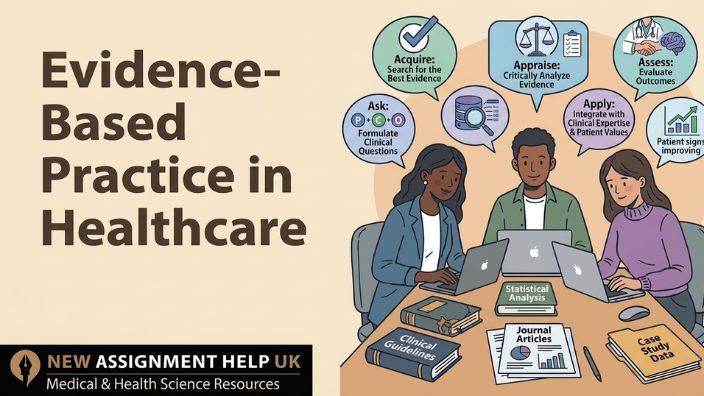
Evidence-based practice (EBP) in the healthcare sector works on a 5-step problem-solving model. It is used to link scientific research, clinical expertise, and patient values to optimise care in this sector. Here is the framework which is required in framing clinical queries to search for, appraise, apply, and evaluate research findings effectively.
- Ask: Turn a patient problem into a clear, answerable question. This is where your PICO framework does an important task by shaping a vague concern into a focused search query.
- Acquire: Go through the most reliable databases for medical literature, such as PubMed or Cochrane Library. And get the best studies which are related to your topic.
- Appraise: Verify the usefulness of each study. Make sure that the results of the study are valid and can be used by you in your practice.
- Apply: Integrate the findings with your own opinion. For this factor, consider the patient's personal values, preferences, and circumstances before making your final call.
- Evaluate: In the last step, measure how the patient actually responded after the intervention. Review what worked, what didn't, and what you'd change next time.
Students sometimes stop at the third step, thinking the job is done once they've found a good study. But it is not like that. EBP only works when you follow through to the final step and actually check them with the real-world result.
Where to Actually Find the Evidence in EBP in Healthcare Studies
Students often waste hours searching for the evidence in the wrong places. So here are the peer-reviewed sources which you can actually look for:
- PubMed/MEDLINE: The largest free database of medical research. You can find millions of medical research articles from MEDLINE and life science journals.
- CINAHL: It is a strong platform for nursing and allied health research studies.
- Cochrane Library: This source is known for high-quality systematic reviews of clinical trials and health treatments.
- Trip Database: Often used for searching clinical search engine results filtered by evidence type and guidelines.
Use the keywords from your PICO question as your starting search terms, and try a few synonyms if your first search comes up thin. A little patience here saves a lot of frustration later.
Popular EBP Models Used in Practice
Different healthcare settings lean on different models to guide EBP in nursing, and each one follows its own structured process. Knowing which model fits which situation will save you a lot of guesswork when you're assigned a class project.
| Model | Best For | How to Use |
|---|---|---|
| Iowa Model | Organisation-wide practice changes | Spot a trigger issue, form a team, gather evidence, then pilot and roll it out hospital-wide. |
| ACE Star Model | Teaching EBP concepts step by step | Move through five points: discover evidence, summarise it, translate it, integrate it, and then evaluate the result. |
| Johns Hopkins EBP Model | Nursing units and clinical teams | Follow the PET process: form a practice question, gather evidence, then translate it into unit practice. |
| Stetler Model | Individual practitioner decision-making | Work through five phases on your own: preparation, validation, decision-making, translation, and evaluation. |
Your instructor will likely point you toward one specific model for class projects, so check your course guidelines before picking one on your own. Once you know which model your program follows, stick with this table throughout your assignments to make it precise.
Final Takeaway
By now, you've learned what evidence-based practice really means, along with how a strong PICO question sharpens your search. You also know why evidence-based practice in healthcare depends on more than just research alone, as it takes clinical skill and patient input working together.
However, EBP isn't about memorising steps for an exam. It is a mindset you'll carry into every patient interaction for the rest of your career. So start with a solid question, follow the process, and always circle back to check if your evidence actually helped. That's the whole game to write the best EBP assignment in healthcare studies.
Are you still stuck on an EBP assignment? Our professionals at New Assignment Help UK will guide you through it with proper analysis, step by step. Reach out today and get expert support.
References
- Melnyk, B. M., & Fineout-Overholt, E. (2019). Evidence-based practice in nursing & healthcare: A guide to best practice (4th ed.). Wolters Kluwer.
- Sackett, D. L., Rosenberg, W. M., Grey, J. A., Haynes, R. B., & Richardson, W. S. (1996). Evidence-based medicine: What it is and what it isn't. BMJ, 312(7023), 71–72.
- Titler, M. G., Kleiber, C., Steelman, V. J., Rakel, B. A., Budreau, G., Everett, L. Q., Buckwalter, K. C., Tripp-Reimer, T., & Goode, C. J. (2001). The Iowa Model of Evidence-Based Practice to Promote Quality Care. Critical Care Nursing Clinics of North America, 13(4), 497–509.
- Dang, D., & Dearholt, S. L. (2017). Johns Hopkins Nursing Evidence-Based Practice: Model and Guidelines (3rd ed.). Sigma Theta Tau International.
- Stevens, K. R. (2004). ACE Star Model of EBP: Knowledge Transformation. Academic Center for Evidence-Based Practice, The University of Texas Health Science Center at San Antonio.
 8 | Master of Science in Nursing (MSN
Sarah Mitchell is a Registered Nurse (RN) and holds a Master's degree in Nursing (MSN) from the University of Manchester. With over 8 years of experience in clinical nursing and nursing education, she has guided thousands of student nurses with their evidence-based practice projects, research appraisal, and clinical decision-making. Sarah has a strong background in applying EBP models in real hospital settings and now she focuses on helping students understand classroom theory and clinical reality precisely.