
How to Structure an Engineering Technical Report
- How to Structure an Engineering Technical Report: A Simple Guide for UK Students
- Standard Structure of an Engineering Technical Report
- What Goes Before the Main Report?
- How Do You Write the Main Body of an Engineering Technical Report?
- The End Sections of a Technical Report
- What Formatting Rules Should You Follow?
- Which Structure Mistakes Should You Avoid?
- Final Thoughts
How to Structure an Engineering Technical Report: A Simple Guide for UK Students
When writing an engineering technical report, you have to focus on one clear idea. A report is a clear story of your investigation. It shows your problem, your calculations, your design choices and your findings in a structured way. UK markers look for a logical order and actionable insights, because it proves you can think and communicate like an engineer. And this guide will help you understand each section clearly, so you always know what goes where. Before we start, let's take a brief overview of the steps involved in this.
Standard Structure of an Engineering Technical Report
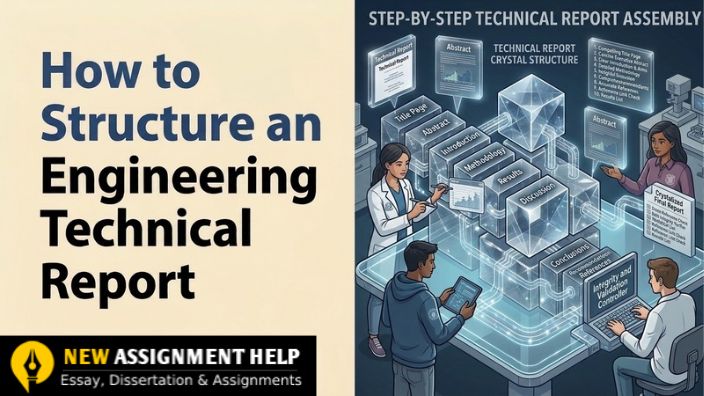
A standard engineering technical report requires you to follow a logical flow from the problem statement to support your conclusions and recommendations. Most UK universities expect the order mentioned below:
- Title page
- Abstract or executive summary
- Table of contents
- List of figures, tables and symbols (if required)
- Introduction
- Background or theoretical framework
- Methodology
- Results and analysis
- Discussion
- Conclusion and recommendations
- References
- Appendices
You do not have to follow this order rigidly. You can change this with your brief and the type of investigation. So before starting anything else, make sure to check your module handbook first. Let’s start with the pages that come before the main report.
What Goes Before the Main Report?
The front pages of the report help your reader find their way around. Think of them as the front door of your report.
- Title page: Your report title, name, student number, module details and submission date.
- Abstract: A short summary of the problem, aims, methods, main results and conclusions. Make sure to write it last, as it summarises your whole assignment.
- Executive summary: Please write a reader-friendly summary of key findings and advice. Some courses ask for this instead of an abstract.
- Table of contents: Lists your headings, subsections and page numbers here.
- List of figures and tables: It provides a visual representation of your report and helps readers find your diagrams and data fast.
- Nomenclature: Explains symbols, abbreviations and technical terms.
Only include the sections which your university asks for. Extra pages will not earn extra marks. Once the front pages are done, you can move on to the main body.
How Do You Write the Main Body of an Engineering Technical Report?
This is the core section of your report, so give it the most care. Each part has one clear job.
Introduction
Explain the engineering problem and its background. State the scope, aims and objectives. Keep the objectives clear, because your conclusion will return to them.
Background and Theoretical Framework
Cover the engineering principles, equations and technical standards that support your work. Mention earlier research where it helps. Also list any assumptions you made. For UK work, refer to British Standards (BS) or Eurocodes where they apply.
Methodology
Explain how you did the work. Include equipment, materials, software, procedures, design criteria and calculation methods. Write it so another student could repeat your steps and get the same results.
Results and Analysis
Show your calculations, measurements, graphs, tables and simulation outputs. Link each finding to your objectives. But keep this part factual. Save the “why” for later, so results and interpretation do not get mixed up.
Discussion
Now explain what your results mean. Compare them with theory. Look at errors, limits and how well the design or test performed.
Conclusion and Recommendations
Sum up your main findings. Say whether you met your objectives. Then suggest practical improvements or future work.
The End Sections of a Technical Report
The last pages back up your work, and here is what each one does:
- References: List every journal, standard, textbook and source you cited, in the style your university requires, such as Harvard.
- Bibliography: Add extra sources you read but did not cite, only if your course asks for it.
- Appendices: Place extra material here, like raw data, detailed calculations, CAD drawings, specifications and software outputs.
Remember one rule. Appendices should support your report. If a key explanation or calculation is only in the appendix, your main body is missing something.
With all these steps, your structure is now complete. Next comes the polish that makes it look professional.
What Formatting Rules Should You Follow?
Good formatting makes your technical work easier to read and trust. Use this quick checklist:
- Use numbered headings and consistent subsection numbers
- Number and caption every figure and table
- Mention each figure and table in your text
- Use SI units and define every variable
- Number your equations where needed
- Keep fonts, page numbers and referencing the same throughout
- Write in clear, professional language
Follow these habits, and your report will look sharp from page one. But even strong students slip up, so let’s see what to avoid.
Which Structure Mistakes Should You Avoid?
Watch out for these common slips:
- Mixing results with discussion
- Writing an introduction with no clear objectives
- Adding preliminary sections you do not need
- Placing diagrams with no captions or explanation
- Keeping key calculations only in the appendices
- Drawing conclusions that your findings do not support
Fix these six, and your report will already feel more polished than most.
Final Thoughts
A good technical report has a clear order, and every section has a purpose. Together, they explain your investigation from problem to result. Always follow your university’s report format, since each UK department can set its own rules. Stay organised, and your engineering work will be easy to follow and easy to mark. Support on engineering assignments is also available if you are facing difficulties.